Andrew, while strolling through the beautiful Loyola New Orleans campus, stumbles upon a mysterious furry creature. The two develop an intimate relationship based on their shared joy of being awesome.
Showing posts with label Andrew Kozaites. Show all posts
Showing posts with label Andrew Kozaites. Show all posts
Sunday, November 21, 2010

Sunday, November 7, 2010
Kozaites, The Outcasts in Blade Runner
 In 'Blade Runner', version notwithstanding, the outcasts are not just the replicants as one might initially assume. It could very well be construed that the majority of the characters in the film are the outcasts considering that they cannot live on the off world. Thereby, they can all be seen as imprisoned in 2019 Los Angeles with Tyrell as their warden.
In any case, the replicants are the outcasts of the outcasts in the movie. It is then important to ask why the replicants are the outcasts- because they are not human. But as W.A. Senior discusses in "Blade Runner and the Cyberpunk Visions of Humanity" the replicants display all the traits of humanity: fight for survival, compassion for loved ones, and other emotions. In fact, the relpicants are almost super versions of humans. This is why they are hunted, and considered the outcasts, because there are so few of them, yet they are so powerful.
Having these killer replicants on earth would surely scare Tyrell, who having sway over the police department, has them declared illegal.
Saturday, October 30, 2010
Kozaites, WWII Politics in Casablanca

The last scene of ‘Casablanca’ is perhaps the most often quoted ending in cinematic history, with “Here’s looking at you, kid”, “We’ll always have Paris”, “Round up the usual suspects”, and “Louis, I think this is the beginning of a beautiful friendship” just to name a few. The reason the ending is so memorable is because of Rick’s selflessness and heroic actions. The use of political expediency in the film further justifies the need to enter into the Second World War and displayed the necessity of it at the time. If Rick represents the American government, then Ilsa became a representation of American lives. However hard it is for Rick to send Ilsa away, it is necessary because Lazlo needs her in order to fight the Nazis. This would suggest that Lazlo represented the Allies in Europe fighting before the Americans entered.
The scene pictured shows everybody looking to Rick, suggesting that he has the power and command. However, Rick is looking at Ilsa, which show that ultimately he cares about her above everything else. They are separated in the scene by Lazlo and Renault implying that the war will, has, and must interfere with the lives of Rick and Ilsa.
The lighting in the film goes from bright and lively to dark and gray hinting that Rick, along with America, would know be entering into a dark uncertain time of war. However this ominous setting is counteracted by Ricks optimistic line concerning the impending friendship between him and Captain Renault. This would suggest that although times would be difficult the American people must persevere in order to win the war.
Friday, October 22, 2010
Kozaites: Social Network Review

David Fincher proved once again his superb skills as a film maker with this year’s ‘The Social Network’. Assisted by Aaron Sorkin’s script loosely based on the founding of the internet website Facebook and its sordid upbringing. At the center of the story is the morally ambiguous and socially awkward Mark Zuckerberg, who through the course of the film gains billions at the cost of friendship. At the end of the movie his stark loneliness accompanied by The Beatles song ‘Baby You’re a Rich Man’ is chilling and leaves you sympathizing with the tragic figure.
The method of story telling within the movie was extremely effective, concerning the flashback and non-linear narrative. Though despite this employment it is interesting to note that the film begins at the earliest part in the story (the breakup scene) and ends at the latest part of the story (final day of legal arbitration). The contrast of these two scenes also shows how Facebook has changed human interaction; in the world before Facebook you would go out for a beer with your friend, in the world with Facebook people hide behind computer screens.
Another strong suit in this movie was the strong acting from the relatively young cast. The fast paced dialogue in the first scene between Rooney Mara and Jesse Eisenberg, Justin Timberlake’s portrayal of paranoid and smarmy Sean Parker, as well as Andrew Garfield’s overall intensity all showcase the talents of these fine young performers.
The method of story telling within the movie was extremely effective, concerning the flashback and non-linear narrative. Though despite this employment it is interesting to note that the film begins at the earliest part in the story (the breakup scene) and ends at the latest part of the story (final day of legal arbitration). The contrast of these two scenes also shows how Facebook has changed human interaction; in the world before Facebook you would go out for a beer with your friend, in the world with Facebook people hide behind computer screens.
Another strong suit in this movie was the strong acting from the relatively young cast. The fast paced dialogue in the first scene between Rooney Mara and Jesse Eisenberg, Justin Timberlake’s portrayal of paranoid and smarmy Sean Parker, as well as Andrew Garfield’s overall intensity all showcase the talents of these fine young performers.
Sunday, October 10, 2010
Kozaites, Mikey Avatar

For my avatar, I chose the character Mikey Walsh (Sean Astin) from the 1985 film 'The Goonies'. I feel as though his character is a representation of myself because of his desire for adventure and relentlessness in his pursuit. I share this quality with him among others. For instance, he has a fascination with the romanticized past almost to the point of delusion. He is easily frightened if the situation calls for it, yet his determination stays in tact. He has a close knit group of friends and a strong older brother. Though at heart, Mikey, like myself, is just a kid with a big imagination who wants to have fun with his friends. Mikey isn't the smartest guy around, but he gets the job done, and he has fun while doing it. These are all things that I admire about him, and similarly share with him.
As of now I don't think I would want to be anyone or anything else, as I am comfortable with who I am. But if I could be (or could have been) anyone, it would be a kid from the Eighties who goes on a grand adventure most kids dream of.
This video shows some of Mikey's flaws and strengths (blind optimism, courage, asthma, hope, etc.)
"Goonies Never Say Die"
Monday, October 4, 2010
Kozaites: Beowulf's Emotions

In regards to further enhancement of a particular scene, I would have to argue that I would enhance every scene featuring a human, by changing the human character from a computer generated image to an actual person. Furthermore, I believe actual sets and locations would have further enhanced the reality of the story. The use of these graphics are detrimental to the overall film, as it seriously limits the acting range of clearly excellent performers. I understand some of these technological inventions were largely essential for the plot, in order to present the grotesqueness of the monsters and severity of the action, however I do not think it was at all necessary to make the entirety of the film animated. I would assert that the film could very well have been both live action and animated, as was done in Robert Zemeckis’s previous film ‘Who Framed Roger Rabbit?’(1988) , to an extent.
In this scene however, Hrothgar (Anthony Hopkins) is showing Beowulf (Ray Winstone), the mystical golden horn, that serves as a major plot device throughout the film. We our first drawn to Hrothgar’s face, who is looking at Beowulf, who is looking at the horn, which causes us to look at these things in this pattern, ultimately being drawn to the bright horn. Beowulf is the dominant figure in this scene, hovering over Hrothgar. Meanwhile Hrothgar is framed by darkness in the upper left corner, and bright gold in the lower right. All in all this scene suggests that Hrothgar wields a power, that will soon be in the possession of Beowulf, however there is a dark foreshadowing to it.
Friday, September 17, 2010
Kozaites: Our Monsters and Imaginations


As times and technology change, so too do the people. Nevertheless stories, through the generations, have remained relatively the same. Werewolf stories have been in existence for hundreds of years. In the very beginning the scary stories were told by word of mouth, creating fear in the listener, and then through written word, creating fear in the reader. At the time, these terror-inducing monsters were complete figments of the imagination. Something never fully seen, only suspected. The whisper in the trees might as well have been the werewolf knocking at your door.
However, with the advent of the moving picture, our monsters became more tangible creatures. Still though, with the absence of the computer graphics we have today, monsters in the films couldn’t be fully realized, still leaving much to the imagination. In the 1941 ‘The Wolf Man’, we never see Lon Chaney Jr.’s entire transformation from Larry Talbot to the Wolf Man. Much of what this character is going through, is left to our imaginations as an audience, often times supposing the worst of scenarios. In contrast, the 2010 version of ‘The Wolfman’, shows the complete and painful transformation of Lawrence Talbot, leaving very little, if anything, to our imaginations. As an audience, we have changed because of this, rather than exercising our own minds, some computer geek in Hollywood has done it for us.
All the same, the basic story has remained the same. There is an innate evil in all of us, and it is our duty to face and conquer our monsters, whether it successful or not.
However, with the advent of the moving picture, our monsters became more tangible creatures. Still though, with the absence of the computer graphics we have today, monsters in the films couldn’t be fully realized, still leaving much to the imagination. In the 1941 ‘The Wolf Man’, we never see Lon Chaney Jr.’s entire transformation from Larry Talbot to the Wolf Man. Much of what this character is going through, is left to our imaginations as an audience, often times supposing the worst of scenarios. In contrast, the 2010 version of ‘The Wolfman’, shows the complete and painful transformation of Lawrence Talbot, leaving very little, if anything, to our imaginations. As an audience, we have changed because of this, rather than exercising our own minds, some computer geek in Hollywood has done it for us.
All the same, the basic story has remained the same. There is an innate evil in all of us, and it is our duty to face and conquer our monsters, whether it successful or not.
Tuesday, September 14, 2010
Kozaites: Heart and Soul
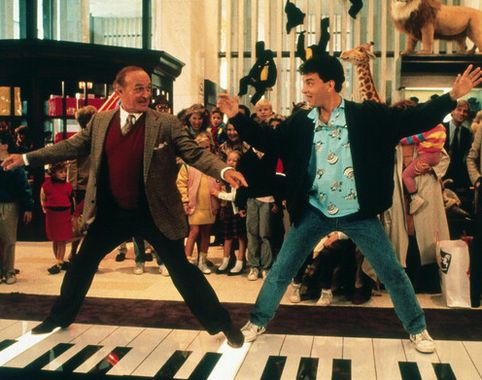
The dominant image in this scene is the lit up piano key at the bottom center. The two main characters each have a foot on this key, and it is in the center between them. Because they each have a foot in the same spot, and they are looking at each other, it creates the sense that they are making a connection. Josh (Tom Hanks) has a light colored shoe, whereas MacMillan (Robert Loggia) has a dark colored shoe, giving a sense of each character. Josh’s light style of clothing versus MacMillan’s dark style of clothing create a difference of personality, yet the way we see the characters interacting suggest a change of attitude on MacMillan’s part.
Both of the main characters each have an open body language; arms up, and legs spread suggesting that everything is safe and harmless. This makes the viewer trust the characters.
The frame here is loose, and the form is open, all creating a lighthearted fun feeling. The character are close to one another giving it a social distance. The camera is a wide shot giving us a sense of freedom.
The crowd in the background, gleefully looking on, create the sense that something fun and exciting is happening, though also making it public. The stuffed animals on the walls evoke a feeling that the location of the shot is in a fun place. All together this shot emits a happy feeling, one that would advise to throw caution to the wind and enjoy life as it is.
Both of the main characters each have an open body language; arms up, and legs spread suggesting that everything is safe and harmless. This makes the viewer trust the characters.
The frame here is loose, and the form is open, all creating a lighthearted fun feeling. The character are close to one another giving it a social distance. The camera is a wide shot giving us a sense of freedom.
The crowd in the background, gleefully looking on, create the sense that something fun and exciting is happening, though also making it public. The stuffed animals on the walls evoke a feeling that the location of the shot is in a fun place. All together this shot emits a happy feeling, one that would advise to throw caution to the wind and enjoy life as it is.
Subscribe to:
Posts (Atom)