Tuesday, November 9, 2010

Goldberg Blade Runner


Blade Runner is centralized to the conceptual conception of free will. Directed Ridley Scott, based off of Philip K Dick, who claims, “I am not a director, I am a philosopher. He poses two questions: A) What is reality, and B) what makes someone Human? Both extremely obscure philosophical questions, yet very futuristic as well asvery important. Is humanity a social conduction? Who does the power of dub another human being more or less human belong to? They may sound like crazy questions, but if you look back throughout history, as well as today, you will find they are not fanatical at all. What did we do to the slaves? Were they not considered 3/4ths human? Or the Indians? Where did all of their land go; what about the Texas Mexican Boarder War of northern aggression – although it is another great example – I was not referring to the civil wars northern aggression either. The Japanese during WWII were they or were they not put into concentration camps, and were their lands not taken? What about the Holocaust? As for today what about the way immigrants are treated?

We don’t know what is “human.” We keep trying to find an answer. People come and people go, who claim to know. Who deem social groups lesser or greater? What is the driving force? Could it be fear? Is the only thing to fear, fear itself?Or is it each other? Dick portrays this idea of what is human In the film, Blade Runner, the protagonist’s name is Rick whose job is to seek out “replicants.” What are replicants? Replicants are humans whohave been created by man. They are programmed to be exactly what their maker wanted them to be. They are perfect hum beings for their intent. They all have memories. Granted they are not their memories, they are other peoples, but did those people not formulate themselves around such memories? Replicants have emotional and physical feeling; they are capable of love. To no surprise I am sure, you can guess they are not treated as humans. They are given a “shelf life” of 4 years, and then they “expire.” The antagonist’s in the film are the “replicants” who are not really antagonists at all they are morethe innocent bystanders of an experiment to which in terms of exponential growth was not fully understood. They just want to find their creator, and be freed, given their “civil rights.” The creators did not fully conceive what they were creating. “Some of the worst things to have ever happened werestarted with the best intentions. “

The film goes on presentingthis futuristically plausible question – what is human -- which is very futuristic, but at the rate at which we are creating technology “replicants” -- or something like them –- will not be so futuristic for as long as some of us may think. Robots are being made all around the world, and Asian is soon to be the “mother” of A.I.. We have not even determined our global rights; we are just beginningto globalize. Yet, we are creating something that will have the ability not only to succeed us all and be our sole demise; but far more confusion another group to deal with, another “other.” If we cannot even determine what it is that makes us human, then howcan we even begin to conceive a world with robots, where we tell them what they are?

K Dick presents the idea of eyes. The thought that eyes are the windows to the soul. So the only way to determine who is or is not a replicant is to perform a test. The test is a compilation of a series of quesitons that are meant to trigger certain emotional activity similar to a polygraph test except a camera is fixated on ones cornea as apposed to pulse. “Real people” can answer all the questions and their pupils will dilate accordingly. Replicants pupils will not. This is a very cleaver idea he presents. Most of the “replicants” are branded not human because they don’t have the emotional ties to things that we do. Yet the film then introduces replicants who can pass these tests because they were produced with the ability to do so. They were upgraded.

This film does a great job of combining, and presenting futuristic concepts and present issues. It, like its ideas are way beyond its time. We are our own worst enemy. We keep producing, and advancing. Yet what are we advancing towards? Is it a world where we will have to have tests to determine if we are human? Are we going to have nature? Are we going to even be here? Does history always repeat itself except to a more advanced level? And if so what is the level that ends it all?

Monday, November 8, 2010

Coulter, Minority Report

As the blind man says as he is dealing drugs to a cop, "In the land of the blind the one eyed man is king." Justice is always shows as wearing a blindfold and holding her scales in one hand and her sword in the other, this represents the three ideas behind social justice; balance, indiscrimination, and retribution. In the film "Minority Report" the idea of blind justice has gone a step further than in the past. In this future world the exists the law enforcement agency of "Pre-crime," where three psychics who can see a murder before it takes place. These people are used to prevent murders from taking place, however this is where their abilities end, only murder tears up the human psyche enough to register in these cognitions. This creates a nearly murder free society of citizens who are terrified of killing someone else, but can negate all other social constructed criminal acts without fear of reparation. As Terri Murray said in the article, "Promoting the deterministic model re-locates social evils in the individual or within human nature itself, while distracting attention from social and institutional inequities." With this system in place the man having sex with another persons wife seen at the beginning of the film feels safe enough in this action to hang around in the park outside of the families home and watch the husband leave, the cop feels safe enough to buy drugs from a dealer in the street, and illegal doctors can preform surgeries to give out new eyes free from punishment. In this type of society justice has turned her eye from everything but the most heinous of crimes while society as a whole suffers without her attention. Justice is out of balance and can not deliver retribution fairly when those who have yet to commit a crime are still sent to jail. The social system of this future world goes without judgment because justice can see only one thing in this land. She represents the one eyed man, who's one eye sees only murders and murderers and nothing else.

Sunday, November 7, 2010

Fisher: Blade Runner

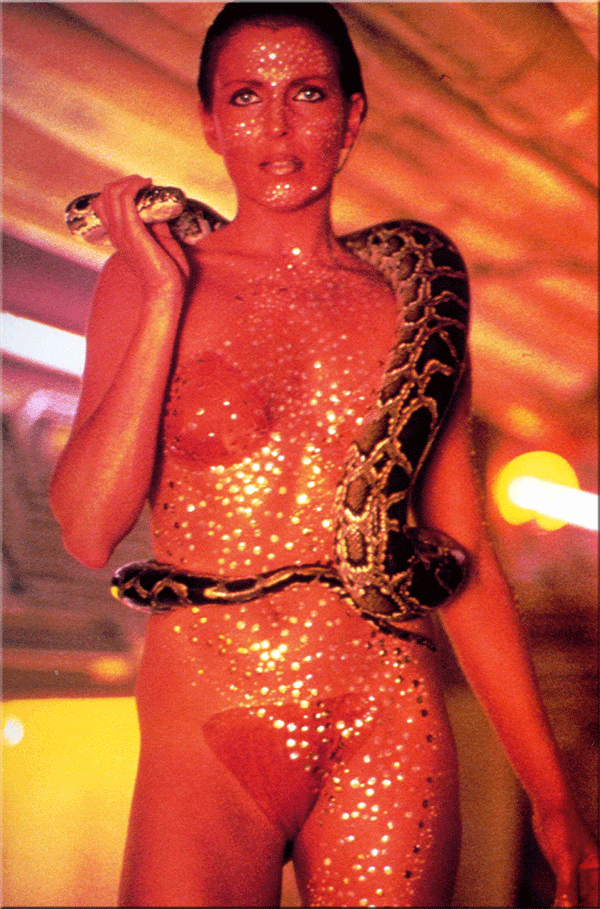
In this film we have a setting that takes place in the future after a nuclear apocalypse in a derelict Los Angeles in 2019.  The world now has a hierarchy within this dystopia, and as we see in the scene between Rick Deckard (Harrison Ford) and his former supervisor Bryant (M. Emmet Walsh) when Deckard originally refuses the job to "retire" rogue androids but is forced to accept because if your not a cop, your a little person.  This reflects on the levels of hierarchy left in the world.  It is still based upon economics and status still but it has an extremely large gap between the rich (Tyrell Corporation), the cops, and those who speak "gutterspeak", the commoners. Below all of this we finally have the androids, made by the Tyrell Corporation.  These beings are considered the low of the low, not even human, even though they are techinically more than human or the epitome of human perfection.  In fact, they do not execute rogue androids, but rather have them retired in a somewhat violent fashion as we see in one of the better scene's from the film when Deckard chases down and retires Zhora (Joanna Cassidy), one of the androids illegally on earth.
So if all of this trouble is being cause by these androids, why do they make them? Why do they constantly improve them to be even more human?  Why are the laws not changed to accommodate these anomalies?  Why do we see that these androids have emotion and want to live?  It is possible to determine if someone is an android by using the Voight-Kampff test, which measures bodily functions such as breathing, blushing, heart rate and iris and pupil dilation in response to emotionally provocative questions which should not trigger a response in a android.  Which could lead us down another route in trying to determine what is human.  In Blade Runner apparently a human is determined by its emotional responses according to the V-K test.  However, we see Rachael (Sean Young) cry after we receive the knowledge that she is an android.  Also, do our memories make us human?  In Blade Runner, Rachel has memories that are apparently not her own and rather Tyrell's niece's, making her much less likely to be human.  Yet at the end of the film it is demonstrated that the androids have memories of there own, and despite having a four year lifespan, they desire to live longer.

Roy Batty (Rutger Hauer)

Mathey, Minority Report


In Minority Report, "criminals" are treated really badly. Even though they did not commit the crime, they are considered criminals because the Pre Cogs have seen their intentions and are always right. However, there is a glitch in the system of pre-crime. When the three pre cogs do not agree on a crime, it creates a minority report which is never going to be revealed otherwise, it would mean that pre-crime cannot be trusted and therefore would have to be shut down. This glitch is used by the bad guy in the movie by trying to make the pre cogs see one crime instead of two. However, Agatha, the more gifted of the pre cogs do not fall for it and warns John Anderton (Tom Cruise) of what is going on. In Terri Murray's essay, "Our Post Moral Future", she argues with the fact that if someone has not committed a crime, he/she cannot be convicted before it happens. She gives an example by citing the opposite. Should we reward people for good intentions before a virtuous deed is done? No we shouldn't so why should we arrest people and treat them as outcast based on their intentions and not their actual actions. So if I went to my friend and said joking " I'm going to kill you" will I be considered a criminal? This would be absurd. I understand that safety should be a priority in this world but at what price. The sacrifice to lose all privacy and control over our life. Becoming puppets of our own world and being scared just to think. The way the criminals are treated in the movie is just horrible. A halo is placed on their head where they would watch their crime over and over again for the rest of their life while being in tube like cells underground. This is even worst than what we do to prisoners in society, at least they have rights and have the chance to prove themselves innocent. In the movie, they just get arrested and are put straight into hibernation state. When were their rights cited? " You have the right to remain silent until you speak to a lawyer, if you do not have one, one will be assigned to you..." Where would the world be without rights ? Indepence is based on them. I do not think that potential criminals like the ones in the movie should be tortured that much. Of course we would live in a crime free place, but I would be scared of the government more than criminals in this case. The power that they acquired based on three genetically modified humans (pre cogs) is just scary.

Malveaux - Minority Report


Minority Report is a film by Philip K. Dick that explores the concept of distributing consequences to someone before their crime ever takes place based on foreknowledge provided by what the film refers to as “precogs”.  The film, set in 2054 Washington, D.C., presumes that any intended act in the future that does harm to society in any capacity is a crime. 
The “precogs, three physics, uses their gift of foretelling the future to determine who, where, when, and at what time someone will commit the crime. The police unit, led by Tom Cruise, then seeks out the pre-determined perpetrator and prosecutes them for the crime they haven’t committed “yet”. According to Terri Murray, in the article Our Post-Moral Future?, a crime is meaningless until it is done, and is a crime precisely because it is done therefore redefining the meaning. Murray also argues that the definition of a criminal is retrospective because the freedom that allows a criminal to choose whether or not to commit the crime is the reason he or she is defined a criminal should they choose to proceed with the act. This is an important concept that isn’t explored in Minority Report. 
The precogs foresee the crime and the police unit acts upon it. Their intentions are to prevent murders, however, they are stripping away someone’s inalienable right, which is free will. What viewer’s should ask themselves after watching this film is at what does a police unit’s obligation to capture criminals infringe upon a person’s right to have private thoughts. 

Penland: Minority Report


In the 2002 film, Minority Report, an experimental police force in Washington, D.C. arrests future murderers based on the visions of three precogs; Agatha, Dashiell, and Arthur. The police force is lead by Captain Joe Anderton (Tom Cruise), who studies the precogs’ visions, gathering clues and information to find the potential murderer. Once he figures out where the murderer is, he and the police force race to arrest him, before the crime is committed, essentially eliminating crime for six years in the D.C. area.

The criminals in this movie are treated as outcasts. Their basic rights are stripped from them; the crime they were arrested for never even happened. Although the precogs are supposed to always be right about a murder, the murderers were only arrested because of something that was going to happen. Terri Murray’s essay, “Our Post-Mortal Future?” addresses this issue, saying “a ‘crime’ is meaningless unless it is done, and is a crime precisely because it is done” (137). This essay shows that the future criminals of this movie were treated unfairly because they never actually committed the crime.

One glitch with this system lies with the precogs. The precogs are human, and could have missed a murder, which does happen in the movie. The murder of Agatha’s birth mother is predicted by the precogs, and prevented from happening. However, the true murderer knows the glitch of the precogs, and commits the murder the same exact way as before. The precogs see this murder, however, the files are erased because it appears to be an echo, which is what happens when a particularly horrific murder is committed, and the precogs see the murder twice. This glitch in the system questions the reliability of the precogs, making the audience wonder if the other murders would have actually happened.

After the criminals were arrested, a police officer placed a futuristic headband on them, forcing them into a sleep-like state, where they could only see their murder over and over again for the rest of their lives. The criminals were then placed in a tube and put underground with the rest of the future criminals, basically tortured with the same image for the rest of their lives. This part of the movie was horrifying to me, because the criminals were completely de-humanized. They became merely bodies without souls after they were placed in these tubes. They were treated worse than the criminals we have today; they literally had no freedom, no movement, and no sunlight.

This clip shows how people in this movie have very little privacy because their eyes are scanned everywhere.

Isaacson: Blade Runner


The central element of Blade Runner is the ambiguity of humanity and the human experience. Occurring in dystopic future where science and technology has greater power over culture than the dreams of the people that inhabit it. In this future humans have perfected "replicants," artificial persons who are exploited by "real" humans as commodities despite the claim by their maker, the Tyrrell Corporation, that they are "more human than human." Humans also remove two of the primary lifelong motivators from the replicants, the ability to have pass on pieces of themselves through offspring and the uncertainty of death, because they cannot reproduce and they have a four year lifespan. This is similar to the controls placed on AIs in William Gibson's Neuromancer and it comes to a similar conclusion; replicants are banned on Earth and an found are "terminated" by a Blade Runner, a police officer specifically trained and authorized to kill replicants.

However, despite theses small differences, the film is incredibly ambiguous as to who really is human. It's obvious that the replicants Deckard, the protagonist and highly skilled Blade Runner, has been hired to terminate are not human; also clear is Rachel's status as a replicant. However, the humanity of ever other character in the film is open to interpretation. We are told by Tyrrell, with the introduction of Rachel, that she believes herself to be human and had false memories of her life before her manufacture implanted so that she might be more human, or at least more emotionally controllable. Both of the Blade Runners, Deckard and Gaff, are solitary men that do not have familial connection and that share many of the eccentricities of the replicants. For example, replicants become heavily emotionally involved with certain objects, perhaps because of the very limited time they have to interact with them; everywhere that Gaff goes he makes an origami figure out of available everyday objects, a bizarre sentimentalization of objects and wish for a personal history when considering this hardened killer. Through this we are also given one of our biggest clues for Deckard identity as a replicant; he dreams/remembers a sequence where a unicorn is running through a field and the final origami that Gaff leaves him is a unicorn, suggesting that Deckard's memories or desires are a scientific matter of filed data which Gaff has access to in the same way that he had access to Rachel's memories. Other characters in the film, from Bryant to Tyrrell himself, are circumspect in their humanity, particularly since none of them can be sure of their own humanity either. Thus, the line between replicant and human is blurred to the point where lifespan and involved emotional response are the only real indicators of the difference; the continued discrimination against replicants is not a matter of their inhumanity but of their inability to effectively fight back given their four year lifespan. They are useful to the ambitions of "real" humans so, much like our slaves now and historically, their humanity is not an issue that the slavemaster is concerned with.