This film is a one minute montage of CC's coffee on Loyola campus. Filmed by Ms. Barkley and edited by Mr. Fisher. We very much enjoyed the creative process of choosing a topic for our film and actually filmed a few movies. However, it turned out that the most simple film fit. The editing process was fun and we will use iMovie much more in the future.
Showing posts with label keller fisher. Show all posts
Showing posts with label keller fisher. Show all posts
Monday, November 22, 2010

Sunday, November 7, 2010
Fisher: Blade Runner

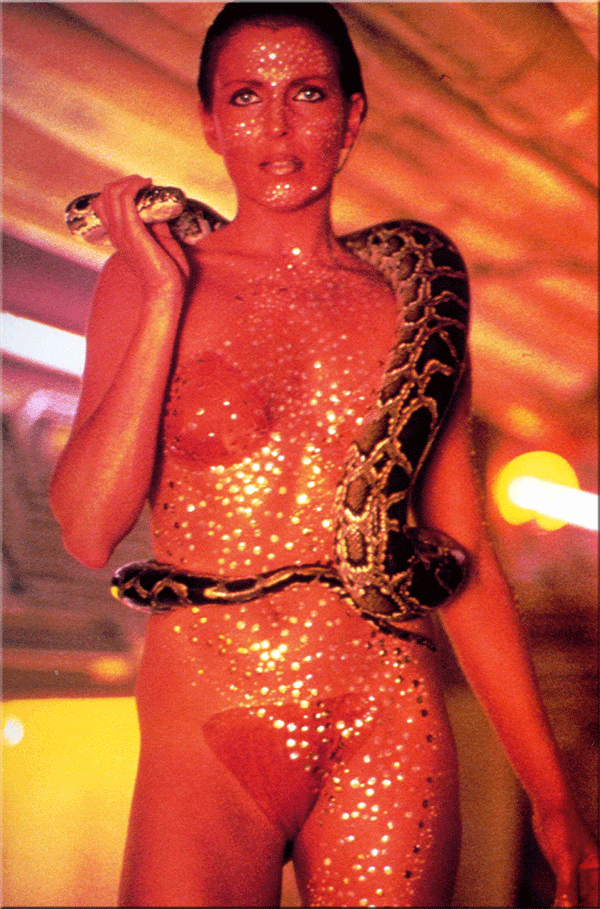
Roy Batty (Rutger Hauer)
Thursday, November 4, 2010
Fisher: Casablanca
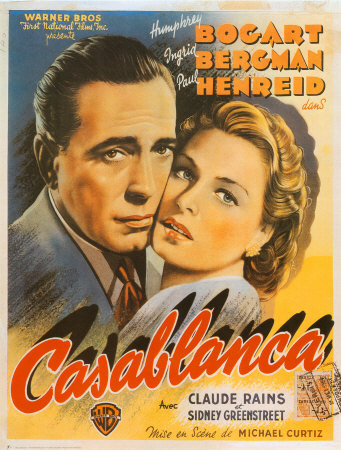
This lovely picture has survived decades of advancements in film and continues to live on as a timeless classic in American Cinema. Much of the film's success has to do with when it came out in theaters and what was going on in the world at the time. The film was based on a play called Everbody Comes to Rick's that was read and bought by Warner Bros. (specifically producer Hal Wallis) in January of 1942. This timing can honestly be seen as impeccable considering the tragedy of Pearl Harbor occurred just a month earlier on December 7, 1941. This allowed for the movie to become the basis for justification by the American public for the United States entering the war. That being said, after America entered the war on December 8 this movie was needed. This time of propaganda, allows for the directors to play with the mise-en-scene in order to convey a political stance or message. Usually, movies tend to try and stay politically objective in order to pull in the widest range of audience.
 However, in Casablanca we see standpoint that was politically expedient to support the United States Armed forces entering the war after Pearl Harbor. In fact they did not show the film in North Africa thinking it would upset the Vichy there. This standpoint is seen in the mise-en-scene of the scene between Rick (Humphrey Bogart) and Ilsa (Ingrid Bergman) at the end of the movie. In this scene Rick has just made known his ulterior motives to Ilsa, and he delivers the famous line, "We'll always have Paris." I would put Rick as the dominan, meerly because he is facing more towards the camera in this frame It can be argued that Ilsa is the dominant because she is more toward the center. Also her white collar adds contrast that draws the viewers attention. But it is Rick (USA) that is making the sacrifices and letting the Ilsa leave with her husband. It took a girl, and a major loss (love) for Rick to finally involve himself in the war. The chief sees this and decides to follow him as a friend and sympathizer. The camera proxemics are intimate because the camera is right up in the faces of these two actors. Trying to capture every emotion, expression, or moment of brilliance. Also the character proxemics are intimate as they are face to face for the entire shot in attempt to convey the deep feelings they possess for one another. The lighting in the frame looks to be high and coming from a little behind Rick, putting Ilsa more in the spotlight. There are some subsidiary contrasts in the picture. The eye focuses on the faces first, then strays to Ilsa's white collar next and finally Rick's black tie. Their staging positions are face to face in the shot in attempt to convey the strong feelings and history these characters have between each other. Finally the frame of the shot is tight and closed, almost could be considered a close-up if it did not have two actors in it. This type of shot is to show the personal relationship between the characters and there emotions in regard to that relationship.
We'll Always Have Paris...
Thursday, October 21, 2010
Fisher: The Social Network
 I had no intention of seeing this film in theaters and was expecting it to be a bust, simply because I was cynical of a movie whose main storyline is derived from Facebook; the ultimate societal conformist's internet outlet since it went public in March 2009. I have confidence in David Fincher as a director; him being responsible for movies like Fight Club, Se7en, and Zodiac. So I was expecting something stable in terms of plot, character, and story development. I was not disappointed by the solid and comprehensive narrative arc presented by Fincher. As for my expectations in terms of acting, the only recognizable names/faces too me were Jesse Eisenburg as Mark Zuckerburg and Justin Timberlake as Sean Parker. I was skeptical of these actors performances due to their limited resumes and my unfamiliarity with their work. However, I had seen Zombieland and Alpha Dog so my hopes for an adequate performance were not completely dashed.
Thursday, October 7, 2010
Fisher: Avatar

My avatar is an sports figure-turned politician. After breaking records and winning championships in two major sports leagues at a young age, he decided to retire early and pursue other facets of life. The next two years of his life are spent in Tibet with the Dali Lama. Upon his return to society he announced his ideas for reform and his intentions of running for office. The public was eager to see change and he won the ensuing election in a landslide.
 |
| Jesse Ventura Fmr. Gov. Minnesota |
 | |||
| Tiger Woods |
In his later years he bought three teams from professional sports leagues (NFL, NBA, MLB) and moved them all to Las Vegas where he built his stadium/casino that could host all three teams at the same time in one night. This is where he lived out the rest of his days attending luncheons, meetings and the occasional strip club.

Fisher: Beowulf
This entire movie could have been reedited in my opinion. It was the first movie that I have seen strive for realism in their animation. This film honestly looks like all of the budget went into the CGI and they had to rush to finish it, so they twisted the story, skipped a few years and made the dragon his son in order to create adequate enough ending to distract the viewer from the fact that they are watching another Hollywood botch of a literal "epic" tale, not just a classic. However, the fact that this story was written so long ago allows the producers and directors to play with it and, to my dismay, add their own creative minds into the mix. In my eyes, this was simply an attempt to make money by taking a timeless Old English epic, bastardize it, and lure in the viewers by tossing a few star names into the digital mix; lets not fail to mention the full digital frontal by the computerized Jolie... that will bring in a crowd of thousands on its own.
All of these were mashed into one movie to produce some form of "finished" product to be presented to the capricious audience that the majority of America is. If I were forced to pick out one scene in this movie to completely reedit, it would be any scene that they deviated from the original tale, which occurs throughout the film. However, a good scene to reedit would be the scene when Beowulf goes to kill the demon in the cave. In the film, and in the book, he takes along his glowing dragon horn that he received from King Hrothgar (Anthony Hopkins) and the sword Hrunting from Unferth (John Malkovich). However, when he enters the cave is where the story completely changes. In the film, Beowulf (Ray Winstone) succumbs to the seduction of the demon (Angelina Jolie) and bears her a child, resulting in the birth of the golden child/dragon and his ultimate demise. Instead of this happening, they could have stuck to the original tale where he slays the demon of the water with a giant sword forged by titans and returns to the mead hall with Grendel's (Crispin Glover) head. Then, Beowulf later meets his fate after slaying a dragon that has no relation to him. Instead, they introduced Beowulf to his "femme fatal" so to speak in the embodiment of a naked, golden Angleina Jolie-demon with some crazy rattail.

 | |
| Demons wear heels? |


Subscribe to:
Posts (Atom)