Friday, October 8, 2010
Jonas G: Beowulf scene
Thursday, October 7, 2010
Fisher: Beowulf
| Demons wear heels? |
Knoepfler, Beowulf
Beowulf. The name itself implies something larger than life, something that runs up, slaps you in the face, insults your mother, and then walks off casually. The way in which this movie was filmed reflects this attitude of excessive manliness and testosterone-fueled action. I’m not going to say that motion tracked CGI is the best way to portray a larger than life film, but I believe it works quite well for Beowulf.
If I were to pick one scene to be re-done, I would choose the scenes of Grendel attacking the mead house. Grendel himself is portrayed as being too far on the monster side than human. The movie Beowulf and Grendel, I thought, portrayed the conflict more on the human side. I think this brings a scarier element to the film. A very mythical, monster-like Grendel kind of brings humor into the scene. It’s very unbelievable. A human Grendel, to me, would seem far more sinister.
When Grendel attacks the mead house, a blue fire is shown burning in the fire pit. It was never explained in the film why a blue fire came from the mead house’s fire pit as he attacked. I would take out the blue fire, and portray the attack through a series of flashes. It would look as though lightning is striking in the house. This brings in the elements of unknown and surprise.
Hales- Beowulf
Every layer of Beowulf exhibits extremely poor use of digital enhancement as well as makes some atrocious faux pas in the realm of filmmaking in general. I believe this scene is an appropriate showcase of everything that is wrong with this film. I understand that motion-capture technology was used in the making of Beowulf and I am sure the filmmakers initially had good reason for this: maybe to save money on actors’ time, attempt to create visual representations on screen out of what was taken from the text, or to make the film seem larger than life. Also, someone in class noted that Beowulf might have been riding the wave of the film 300 and its box office success. But whatever the reasoning was behind it, the digital enhancement fell flat. The actors appear to be made out of clay and the costumes look like they are from Shrek. In the scene above, Ray Winstone’s character is mannequin-esque even, his eyes have no depth and his body appears completely sculpted (in the literal sense.) And of course, let’s not forget what Ray Winstone actually looks like…
Tuesday, October 5, 2010
Kehoe-Beowulf
The CGI in Beowulf is so poorly rendered that the charters movements and facial expressions appear wooden and unrealistic. This lack of life like qualities is most apparent in the scene where Beowulf fights Grendel. Especially when there is a lot of movement going on, such as when Beowulf jumps up onto the chandelier, the movements seem unrealistic. The physics of the characters movements seem artificial and cartoonish, rather than real world physics. By physics I mean things like how a person looks while walking or running and how a person falls when being hit by a powerful force. I feel that if more attention had been paid to imitating real world physics the film would be much more visually pleasing.
Cooper Beowulf
In the scene below everyone's movements are stiff and choppy. Also the lack of animation on their faces adds a creepiness level to the whole film because it makes it feel like everyone is a zombie. The lighting in the scene also made everything hard to see, and though it seemed like they tried to keep it realistic with how much light the torches would produce, they ignored where the torches were placed and did their own lighting scheme.
Also, I can never forgive when character's are unbelievably stupid. That Norseman has to know that if goes to open that door he will die. They know that Grendel enjoys coming to their mead hall and killing everyone inside. Why would that change?
The fight scene itself shows Beowulf becoming a ninja and leaping from rafter to rafter until he expertly surprise attacks Grendel like Batman would one of his victims. The thing about this is that Beowulf is a viking. He's not suppose to leap around in the rafters. He's suppose to run up to Grendel, punch him in the face, and then rip off his arm.
Beowulf essentially fights like a coward in this fight.
Its because of scenes like this that a potentially epic movie falls short of everyone's expectations and I'm willing to bet this movie didn't drive anyone to go back and read the epic tale its based off of.
Monday, October 4, 2010
Sanders- Beowulf
Kozaites: Beowulf's Emotions
In regards to further enhancement of a particular scene, I would have to argue that I would enhance every scene featuring a human, by changing the human character from a computer generated image to an actual person. Furthermore, I believe actual sets and locations would have further enhanced the reality of the story. The use of these graphics are detrimental to the overall film, as it seriously limits the acting range of clearly excellent performers. I understand some of these technological inventions were largely essential for the plot, in order to present the grotesqueness of the monsters and severity of the action, however I do not think it was at all necessary to make the entirety of the film animated. I would assert that the film could very well have been both live action and animated, as was done in Robert Zemeckis’s previous film ‘Who Framed Roger Rabbit?’(1988) , to an extent.
In this scene however, Hrothgar (Anthony Hopkins) is showing Beowulf (Ray Winstone), the mystical golden horn, that serves as a major plot device throughout the film. We our first drawn to Hrothgar’s face, who is looking at Beowulf, who is looking at the horn, which causes us to look at these things in this pattern, ultimately being drawn to the bright horn. Beowulf is the dominant figure in this scene, hovering over Hrothgar. Meanwhile Hrothgar is framed by darkness in the upper left corner, and bright gold in the lower right. All in all this scene suggests that Hrothgar wields a power, that will soon be in the possession of Beowulf, however there is a dark foreshadowing to it.
Gevry- Beowulf
I cannot think of one scene, alone, in Beowulf that needs to be edited- I simply didn't like any of them. Perhaps the fact that the movie was shot to be shown in 3D that its effects were diminished while viewing it in 2D, but on a whole I just found the film lackluster. Do not get me wrong the technology used is state of the art, the CGI amazingly done, and extremely impressive but the film lacked that humanistic quality that comes with real life actors, the quirks that allow one to fall in love with the, the subtleties that allow one to connect with them, and the misgivings that force one to despise them. True human emotion is what lacks in Beowulf's scene. Being that the entire film is computer generated the audience doesn't give the same response to the characters as they would had actual living, breathing actors played the roles. So to ask me to enhance one scene that would improve the movie would be impossible because, for me at least, that would be the same as redoing the entire movie. Beowulf is an entertaining and action packed film but it falls short from being anything substantial.
Cardon - Beowulf

Overall I was not impressed with Beowulf, whether it is on screen or in print. Adding to my dislike of the story, Robert Zemeckis (the director) chose to do the entire movie in CGI (computer generated imagery). Someone in favor of CGI may argue that it adds to the mythical aspect of Beowulf’s story, but to me it makes it look like one of those low budget Barbie movies that go straight to DVD. Seeing as how we are to pick only one scene from the movie to enhance (I would enhance the whole damn movie) I would have to go with the fight scene between Grendel and Beowulf. For starters, Beowulf fights naked. That decision was clearly not thought out. Due to Beowulf being naked, his movements are very rhythmic/poetic in order to hide his genitalia, which makes him appear stupid in what is supposed to be a badass fight scene. If they would have chosen to put a loincloth or something over Beowulf’s manhood, then perhaps the fight could have been choreographed properly, rather than looking like a routine for ribbon dancers.
In the picture split into two of Beowulf, the image on the left is what I will analyze in regards to mise en scene. The dominant is the sword that is lodged in the ground. Conveniently it is placed directly in front of Beowulf’s private parts, which suggests something about Beowulf himself. The lighting key is rather high coming from bottom to top. He is lit to look like a great hero rising from the darkness. In the frame we see all of Beowulf except his feet, so it is a long shot but the sword is in the foreground. The camera is slightly tilted up to give him the grand appearance.
Himmelberg- Beowulf Scene
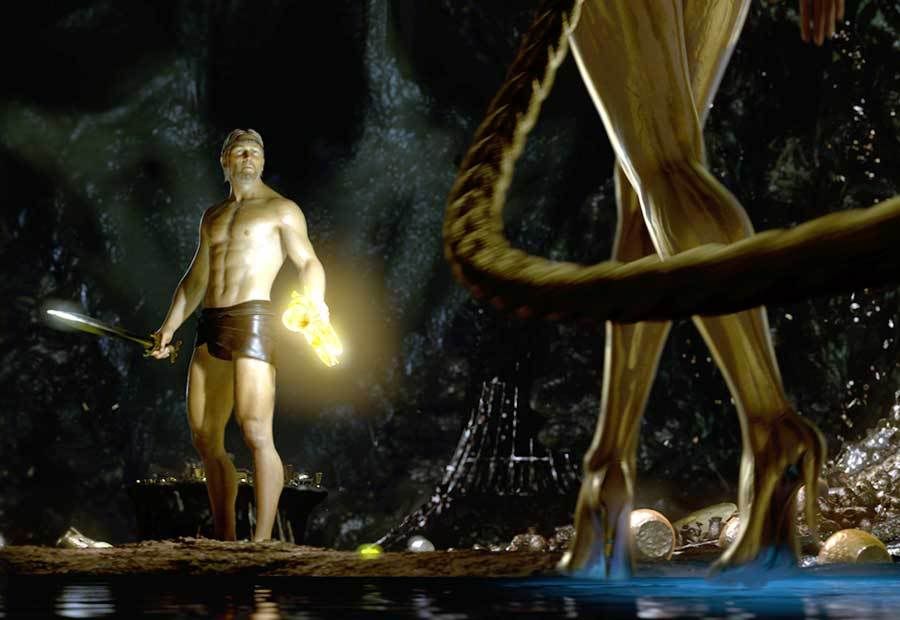
ant part of Beowulf.The scene that I picked to change was the scene where Beowulf goes into the cave to see Grendel's mother. I think it need works because it is simply catering towards angelina jolie
and her "sexiness". I know t
hat Grendel's mother is supposed to be alluring but she bordering vulgar in this movie. There were three major things that bothered me about the scene. First that when Beowulf stepped into the cave the golden horn/goblet started glowing. This happens both times he goes into the cave and it is never explained as to why the thing glows. It doesn't add to the story or enhance the scene at all it just leaves the audience wondering why the thing is glowing, which we never find out so it is slightly frustrating. Second, Grendel's mother is surrounded by a blue light when she emerges from the water and this same blue light appears numerous times throughout the movie. Again I do not think it adds anything to the scene or the character, it simply confuses the audience because it comes into the room when Grendel is in the mead hall attacking people, it again shows up when grendel is hurt and dying and then when she shows herself to Beowulf. Is she supposed to be represented by the blue light or is it the magic? We never get an answer to that so it is simply fluff and not needed to portray her character or the magic that is going on either. The third thing is the fact that as Grendel's mother walks out of the water she is covered in what looks to be gold paint. As she continues to walk out the "gold paint" starts to disappear. This seems absurd, and is obviously the directors way of making the scene even or sexy. I think it jsut adds to the vulgarity. At least if she is covered in gold we know that she is not human, but when the gold starts to come off it gives the impression that she is part human and she is not, so it giving the audience a wrong impression of her character. I also think all of the little balls of light that are flying around can be gotten rid of because it gives the scene an air of good magical feeling when it is actually very bad and seducive. It made me think of peter pan or some kind of fairy movie, which is not the feel the scene should be having. Overall I think this is scene(and it takes alot for me to say this) should give off a more dark and eerie vibe instead of a magical fantastical one.Mise En Scene (first picture of angelina jolie's head coming out of the water )
Dominant - Grendel's mother
Lighting - Low lighting
Camera Proxemics - intimate -
Sunday, October 3, 2010
Rickert, Beowulf Scene
Azreen I., Beowulf
Falanga, Beowulf Mise En Scene
One particular scene in “Beowulf” which deserves some editing attentions is about an hour into the movie when Beowulf confronts Grendel’s mother for the first time; The dominant is on the golden horn when it should be on the faces of either character, the object is too bright and detracts attention from the important dialogue and confrontation going on. The lighting is very low all around the two characters while the horn creates much of the light on the bottom right of the screen which illuminates much of the two characters on screen. The character proxemics is intimate as we only see from the chest up on both the characters and their heads fill up most of the screen. The camera is about three feet away from the action going on in the scene. The angle of the camera is somewhat tilted up toward the characters’ faces, as if we are looking up to them as they are both legends in their own worlds, giving good symbolic reference to who these characters are. The color is gold for the most part as it fills the characters’ faces giving them a magical quality; while the rest on screen in the background is pitch black. There was no lens/stock/filter change in this shot as everything is very clear and not distorted in any way. The subsidiary contrast is that of Beowulf’s face because it is closest to the bright gold horn, then the mother of Grendel which is at the other end of the screen and not so lit up is the next subsidiary. The fact that neither character is as brightly lit up as the horn makes them subsidiary contrasts. The scene is not very dense because we only have two characters in close proxemics to each other while everything is in darkness. They both fill the screen making it somewhat dense but there is nothing in the background making it easy to see what is going on what to look at. The composition is interesting; the only objects we can see on screen are the two characters, whilst everything else is in darkness making it impossible not to focus in on the conversation and confrontation. The framing is very tight, Beowulf and the mother are close together in a dark cave with only one light source being the horn, and the characters seem to have nowhere to go making a good representation of how critical this plot turn is as it is made necessary through the way it is shot. There is not much depth in this scene because we are allowed only to focus on three things (Beowulf, Mother, and horn) which are all in close proxemics of each other. As far as the character placement, Beowulf is on the right holding the gold horn near the bottom right of the screen, while Grendel’s mother is on the left. The characters don’t look into the camera and only look at each other, the camera goes around the dialogue at hand but they never change positions in the stage position. The problem with the scene is that the horn should not illuminate the screen as much as it does. It draws attention away from the confrontation. The animation and people look awful in this film, mainly because the character’s faces can’t move and express that much as a normal actor could.
Villavicencio--Beowulf
Although countless scenes throughout Beowulf are in dire need of some editing (such those with supernatural characters or gruesome battles), I found one scene that perfectly exemplifies why films made entirely by CGI fail so miserably.
Around the 70th minute, a man is seconds from his murder when he requests Beowulf himself to take his life. Sensing mockery, Beowulf decides to explain “man with no name” exactly why his energy would be wasted on physically killing him himself. Throughout this short scene, Beowulfs emotions (are supposed to) change from self-content, to offense, to pride, to pity and almost (if possible) sympathy. Unfortunately, his facial expressions hardly portray much more than on emotion (most likely arrogance.) The “nameless” man’s emotions should have moved from terror, to confusion, to extreme fear, and finally intense relief. Instead, however, his cartoon-like shuddering and lack of true emotion from his face to body language are more significantly more distracting than convincing.
Although maybe not a key scene, this conversation exemplifies why digitally enhancing human characters is a unfavorable choice. The only true way I can suggest to improve the scene would be to use real people.
Fairly successful CGI movies could be Spider Man, The Mummy, and King Kong, however they merged real people with their supernatural co-stars rather than transforming everything. Given the obvious knowledge that supernatural characters are not real, the CGI doesn’t take away from the film as it does when real people are forced into animation.
Saturday, October 2, 2010
Nolley-Beowulf
The scene in Beowulf that I feel needs the most editing is the one where Beowulf fights Grendel. In this scene, the lighting is constantly flashing, similar to a strobe light. While this style of lighting can be effective in showing a fast paced sequence, this scene was a bit too intense. The constant flashing made it hard to make out what was actually happening and was distracting from the meat of the scene. The overall effect of this style is lost in the drawbacks of using the technique. It seemed like during the scene the viewer never got a decent look at what was happening and it created a lot of confusion. In order to fix these problems, I would either abandon the idea for good or greatly reduce the speed at which the light flashed. The first option is the most desirable and the most effective in producing a straightforward scene. This scene is also the first turning point in the movie which makes it a pretty important event. In order for the viewer to absorb the whole point of the scene, they would need to be able to see it clearly and accurately. There were several times when I found myself questioning who was attempting to fight Grendel at one particular time or another, and couldn’t make out the face in the awkward lighting. In order to remedy the problem a montage of Beowulf and Grendel fighting could be put in place of the strobe light effect. This would still give the impression of a rapid time sequence, but would be easier for the viewer to enjoy. It seems that a lot of techniques used in Beowulf were experimental and exciting, but techniques like this are not always the most appropriate to use in a movie.
Westerfield: Beowulf's Arrival
When analyzing Robert Zemeckis' Beowulf, one has to keep in mind the film was originally screened in 3D and as such several of the scenes were designed to exploit that effect. Consequently, we have scenes like Beowulf's arrival to the shores of Hrothgar's lands, where he is greeted by a mounted soldier and has a spear thrust in his face in such a way that, to the audience of the 3D version, it looks like it's protruding out at them. But, regardless of dimension this is an awkward scene. The spear point doesn't so much come forward as simply appear and the knight's arm doesn't even move the spear while this is happening. This exaggerated perspective combined with the tight framing obscures the level of depth within the scene so that the spear looks cumbersome instead of dynamic. Part of the purpose of this camera angle is to serve as an equalizer, by placing Beowulf at the same height as the mounted soldier as it pans left. If anything the height difference should be emphasized, like through an over-the-shoulder shot from the back of the soldier looking down on Beowulf so that it could be contrasted with his defiance of the native authority.
The lighting of this scene positions Beowulf as the dominant of the scene by utilizing the primary contrast of the orange and yellows of his skin and hair against a relatively blue and vacant background. It's difficult to comment on the effectiveness of the lighting key because of the use of 3D, which has the side effect of making the general lighting of a film darker, but for this scene the choice of a stylized look works relatively effectively. The only qualm here is the lack of reflective lighting within the eyes of the characters.
Isaacson: Beowulf-SceneAnalysis

One scene in the movie Beowulf that needs work is the death sequence for Grendel. The lighting is low key and comes from the water in the cave that the scene is set in; also, Grendel's mother appears to glow in the dark which leads to a confused lighting from both above and below with muddles the contrast and makes the scene feel fake. Camera proxemics are personal with the scene being shot from above and Grendel, who is lying on the floor of the cave, stares almost directly into the camera as he dies. This makes the viewer feel a connection with him when he is supposed to be the monster and until that point has been portrayed as such. The character proxemics are intimate, with Grendel's mother stroking his head as he dies. However, the director decides to keep her mostly out of the frame which ruins any feeling of intimacy that exists between the two characters. The dominant is Grendel, since he takes up most of the space in the shot and is placed in the center of the frame, but he also blends in with the background and the only contrasting element are the seconds of Grendel's mother's glowing hand and her face in the reflection of the water. The form is open, suggesting that there is much out of frame which we cannot see. However, in a scene that is supposed to reveal more to the viewer about the antagonists and their motivations this seems to suggest that we will never see the whole picture. Finally, because of certain mistakes like the water not glowing anywhere except to help contrast Grendel from the floor of the cave, the CGI feels fake and sloppy to the viewer and betrays any suspension of disbelief s/he might have had.
Barkley-Beowulf, Father Son Battle
Becnel Beowulf and the Mermaid
After this sea monster battle scene, the scene that I feel needs further editing begins.
The Mis En Scene of the mermaid scene:
Dominant: The dominant in the scene is the mermaid. Our eyes are drawn to her first and for the longest amount of time. We are intrigued by her; Beowulf said he fought a monster, not a beautiful mermaid and we are curious to see what happens.
Lighting Key: The lighting is very low and the scene is comprised of dark colors: the deep blue/green of the sea and the darkness of the depth of the sea.
Shot and Camera Proxemics: The camera is at first far away( a social to public proxemic) from the mermaid, but as she reveals herself and swims towards Beowulf, the shot becomes more of a close-up (an intimate proxemic).
Angle: The camera is level for most of the scene, but slightly tilted down when she comes up to Beowulf, as if we are seeing her from his eyes.
Color Values: The dominant colors are the dark blue/greens of the ocean. The darkness also helps with the foreshadowing of Beowulf's downfall (his inability to resist or kill bewitching women).
Lens/Filter/Stock: The scene had a cloudy look to it when the mermaid was revealing herself.
Subsidiary Contrast: The second thing that catches our eye, after the mermaid, in the scene is Beowulf. The last thing our eye focuses on is Beowulf's sword falling to the bottom of the sea.
Density: There is not too much visual information in this scene. The mermaid and Beowulf's encounter gives information, but it is just the empty sea background and them in the scene.
Composition: The background ( the sea) and the middle and fore ground seem to blend in together.
Form: The form is open and natural. It does not seem to be closed or stylized. Not taking the fact that this scene needs more editing into consideration, it does have more of a natural feel than a fake or choreographed feel.
Framing: The framing is loose; the characters are allowed to move around the scene freely.
Depth: Even though the movie is animated to feel like a 3D film, this scene seems very 2D.
Character Placement: The mermaid occupied the center, the left, and the lower center of the scene, whereas Beowulf occupied the upper right and center of the scene.
Staging Positions: The characters do not look into the camera. The mermaid looks towards the camera, but not directly into it. Beowulf looks at the mermaid, and at one point has his back towards the camera.
Character Proximics: The characters start off in a social proxemic, end up in intimate proxemics from one another, when they embrace.