This movie was our take on a thriller/suspense movie with a funny twist at the end. The majority of the film was shot in Audubon Park and Loyola's campus. Azreen does an amazing job is being a total creep in this one minute film. We also wanted to make fun of how Dominic was so freaked out by such a tiny person. In all, the project was enjoyable and we had a lot of fun. It was amazing to us how we were able to successfully shoot this movie in less than forty minutes and edit it in such a short span of time. Hopefully everyone will enjoy it (especially Professor McCay :]]).
Showing posts with label taylor nolley. Show all posts
Showing posts with label taylor nolley. Show all posts
Monday, November 22, 2010

Saturday, October 30, 2010
Nolley- Casablanca (the right one)
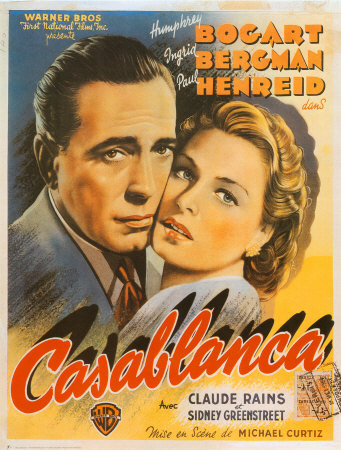
The political expediency theory in Casablanca influences the audience’s feelings toward America’s involvement in World War II. The audience becomes sympathetic toward Rick and he is the focus of the film, character wise. He represents America and its transition through World War II. In the beginning of the film, he is indifferent to the events going on around him and he is focused on running his business. But when Ilsa enters the picture, his idea on the issues going on changes and by the end of the movie he does what’s best for everyone. This illustrates how America’s entrance into World War II was a necessity and how in the end it was the noblest thing to do. This change is a commentary on how America was determined not to enter the war, but realized if they did not it would hurt more people in the end. Ilsa was the motivation for Rick to do the right thing, just as Pearl Harbor was the last straw before the U.S. entered the war. The events surrounding Ilsa and Victor showed Rick that he needed to act in a selfless way in order to help the bigger picture. This film is used to justify America fighting in World War II. It showed the viewers that sometimes fighting is okay if one is fighting for what is right. Casablanca allows the audience to feel comfortable with such a huge event in history. It creates confidence in America and shows that with the support of its citizens, things will turn out okay. The political expediency theory gives Casablanca the underlying political message needed for that time in American history.
Friday, October 22, 2010
Nolley- Easy A

The movie I saw over fall break was Easy A starring Emma Stone and Amanda Bynes. Now I know what you guys are thinking, “why would anyone want to willingly see that movie”? And I’ll tell you something, it was pretty entertaining. It definitely had those cheesy moment where you feel awkward that you’re actually watching this movie, but all in all it made me laugh and connect with characters which is the basic aim of any film (well not always laughing; sometimes crying, screaming, etc. but you get the point). The way it was edited together made for an interesting film, because every once in a while Olive (Emma Stone) would interrupt in order to give more input into the scene at hand which gave a more personal feel to the movie overall. It was funny to see the return of Amanda Bynes considering the character she played was a super Christian, which she brought to life very well. All of the actors seemed to complement one another very well, which helped achieve movement through the film and put the audience in a comfortable position with the characters. Now like I said, the movie did have a few parts where it was overly cheesy, but that is to be expected in a teen flick no matter what year it is. Sixteen candles, Pretty in Pink, practically any Molly Ringwald movie you’ve seen, has this certain comedic, cheesy charm that can not be passed up. It is a classic aspect of any teenage film you are ever gonna see, and that’s what makes them so fun to watch.
Sunday, October 17, 2010
Nolley- George of the Jungle

The scene that I felt had the best use of movement was the scene in which George was swinging on his vine trying to impress Ursula. The movement in this scene created a very comedic feel that helped lock down the movie as a children's comedy. The use of a dolly shot in the scene was helpful in creating a swinging feel. It was more effective than if the camera had remained in one spot and briefly caught George swinging. With this technique the audience has the feeling of swinging right next to him which makes them more present in the scene. It seems apparent that in this film movement is used to revamp the comedic feel. In other scenes (like the dog/elephant scene), the movement of the camera is used to emphasize the campiness of the film. It even adds a bit of suspense to what George's dog actually is. The fact that the camera is shaking, showing that the ground is rumbling from something quite large, makes the audience question what on earth George could be calling toward him and Ursula. This technique helps to peak the audience's curiosity and the scene would be much less effective if the camera movement had not been used. The combination of sound and movement can create a whole new feel to a scene and create a much more enjoyable experience for the viewer. George and the Jungle uses movement in interesting ways to achieve an extremely cheesy feel to the movie. This campy essence is what has made George of the Jungle the family classic that it is today.
Saturday, October 9, 2010
Nolley- Avatar Blog

Cicadas
The avatar that I have chosen is an image of a cluster of cicadas. Cicadas have an interesting life cycle that produces powerful, yet vulnerable insects. My connection with cicadas stems from multiple layers of meaning they represent to me. A cicada starts its cycle underground and remains there for years of its life. When they finally do emerge, their skin is shed and life as they know it is over. Cicadas and I have grown up in similar situations. Like the cicada, I have emerged from my life as a child into the adult world where things are immensely different and my opportunities to grow are endless. The exoskeleton of an emerging cicada is similar to the barrier I put between me and new acquaintances. It is only when I am truly comfortable with someone that I allow them to see me for who I am. Although cicadas are powerful insects, they have weaknesses just like every other insect. This is true for me as well in that while I am strong in times of need, I am still affected by problems just like every other human. Cicadas are truly magnificent creatures with a certain uniqueness that can seldom be rivaled in the insect world, and they are the perfect representation of how I feel as a person. From their birthing habits to their means of developing, their rituals are relevant to my own life and provide a beautiful interpretation of the trials and tribulations that have molded me into the person I am today.
Saturday, October 2, 2010
Nolley-Beowulf

The scene in Beowulf that I feel needs the most editing is the one where Beowulf fights Grendel. In this scene, the lighting is constantly flashing, similar to a strobe light. While this style of lighting can be effective in showing a fast paced sequence, this scene was a bit too intense. The constant flashing made it hard to make out what was actually happening and was distracting from the meat of the scene. The overall effect of this style is lost in the drawbacks of using the technique. It seemed like during the scene the viewer never got a decent look at what was happening and it created a lot of confusion. In order to fix these problems, I would either abandon the idea for good or greatly reduce the speed at which the light flashed. The first option is the most desirable and the most effective in producing a straightforward scene. This scene is also the first turning point in the movie which makes it a pretty important event. In order for the viewer to absorb the whole point of the scene, they would need to be able to see it clearly and accurately. There were several times when I found myself questioning who was attempting to fight Grendel at one particular time or another, and couldn’t make out the face in the awkward lighting. In order to remedy the problem a montage of Beowulf and Grendel fighting could be put in place of the strobe light effect. This would still give the impression of a rapid time sequence, but would be easier for the viewer to enjoy. It seems that a lot of techniques used in Beowulf were experimental and exciting, but techniques like this are not always the most appropriate to use in a movie.
The mise en scene of the above still points out a few of the flaws of the scene. The dominant is Grendel, but he is very blurry and a little washed out. This gives an idea of how hard it is to make out the actual scene. The lighting key is high directly on Grendel, but becomes low as you look to the corners. During the actual scene there are a lot of flashes of high lighting, but no lighting key is used consistently which can become very tiresome to watch. The camera proxemic is personal with Grendel's hand almost touching the viewer. While this is creepy, it loses it's edge because of the low quality of the image. For those not viewing the movie in 3D the effect is totally lost.
Sunday, September 19, 2010
Nolley, Wolfman Comparison
 The Wolfman: 2010
 The Wolfman: 1941
The 1941 Wolfman has some elements that the new 2010 version left behind. In the 1941 version the Lon Chaney is seen changing into the wolfman. This change is documented by his feet growing extremely hairy. It can definitely be said that the transformation into the wolfman is most definitely toned down in the 1941 version. This may take away from the overall scariness of the transformation, but it keeps the idea that there is still a man under that fur because his body has not been severely contorted. In the 2010 remake, Benicio Del Toro is extremely frightening when he transforms because of the dramatic changes his body goes through. It was almost too much, the way his fingers bent and how his jaw practically came off of his face. One thing that is worth admiring about the remake is that after he transforms and when the viewer finally sees him in all his glory he is not computer generated. This is reminiscent of classic horror movies where you can tell there’s a person in there. It also helps reinforce that Lawrence Talbot is a wolfman, not just a wolf creature with no obvious human characteristics. While the remake of The Wolfman is indeed more frightening than the original, that does not make it better. The computer generated effects of the remake take away from the genuineness of the film because the audience becomes distracted by what’s fake and what’s real and can lose track of the story itself. The 1941 Wolfman has an originality that the remake could never compare to.
Thursday, September 16, 2010
Nolley Demonstration Blog

Malibu's Most Wanted (Jamie Kennedy, Taye Diggs, Anthony Anderson)
This is one of my all time favorite movies, because personally I think it's hilarious. This particular scene is quite comical and by analyzing it using mise en scene one can understand the elements that make it so funny. The dominant in this scene is obviously Jamie Kennedy. He is placed right in the center and he is the brightest and most in focus person (not to mention the only white person in the theater). There is also no one seated in front or directly behind him which helps to make him the most obvious object in the frame. The lighting key seems to be high key directly on Jamie Kennedy and lower around the rest of the audience. The light appears to be coming from the projector above them and possibly from the screen itself. It looks to be a little too bright for a theater in order to be natural lighting. The camera proxemic range is social at about ten or so feet. The character proxemics however are intimate. This creates an awkward and uncomfortable feeling for Jamie Kennedy a.k.a. B-rad G. The character proxemics re-affirm the problems B-rad is having throughout the film. He has been kidnapped and his whole way of life is being invaded and turned upside down. 'Bloodbath' (Anthony Anderson) and 'Tre' (Taye Diggs) are invading his personal space just as they have invaded his personal life.
This frame helps to complement the large scene because it brings about the feel of awkwardness and the impending outburst. In this scene Brad is being forced to "act white" so that he won't be shot. In order to test if he has really changed Bloodbath and Tre take him to a scary movie. This is the frame right before he can no longer handle the movie and throws his popcorn, making a huge scene. The calmness of the frame helps make the outburst even more intense. It creates a sort of suspense of whether he'll be able to control his urges to "act black". I love this movie simply because it's a funny commentary on how you can't change who a person is and the color of someone's skin has nothing to do with who they are inside.
Subscribe to:
Posts (Atom)