Casablanca is a film that stayed neutral despite being filled with political undertones. Almost everything about the movie focused on the war and politics, but the filmmakers did an outstanding job at making sure Casablanca would not alienate or insult its audience. A lot of that has to do with the time of its release. In the early 1940s the film industry was growing, and Casablanca was merely another studio film intended to make money. Sure, it was a great one that would have a lasting legacy, but Warner Brothers wasn't trying to shape anyone's political views. Had there been political controversy in the film, it most likely wouldn't have had as much exposure. But who knows, maybe some controversy would have made Casablanca even more of a masterpiece.
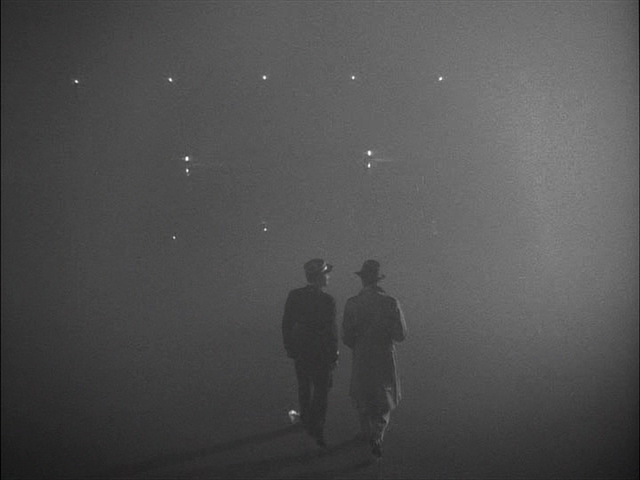
In the closing scene of Casablanca, Rick and Renault disappear into a cloud of fog, which is symbolic of the political haziness of this film.
The dominant in this frame is the fog, and the subsidiary is the two men. The first thing we notice in this frame is the overall haziness. This creates a mystery as to what the future holds. The proxemics are public, as we are watching them walk off and left as bystanders in the situation that just took place. The lighting is very dim, with the exception of in front of the two men, where you can see a glow shining upon them. This shows that there could be a bright future waiting for the two men, hence the line "Louis, I think this is the beginning of a beautiful friendship."
Prior to the release of the 1942 film, Casablanca, producers envisioned reasonable success but soon found out they'd created one of the most popular films of all-time. Its success is often attributed to its wide appeal as it truly captured the zeitgeist of Americans in the late 30s-early 40s. The suspense of the unraveling love triangle grabs most viewers attention and keeps them interested, but there is undoubtedly a political allegory behind the film that truly impressed upon the viewer, particularly due to the timing of the film's release. The film is set in December 1941, the month of the Japanese attack on Pearl Harbor. The zeitgeist of the 1930s was one of political neutrality and anti-war sentiments; however, this attack immediately changed opinions and soon changed actions across the nation.
In many ways the protagonist of the film, Rick, represents the average American man that most viewers could easily relate to themselves (or members of their family). He initially represents the average man before America's entrance into the war - a drinker who resents a past relationship, holds apathetic views on the war and American politics, and is narrowly focused on doing things in his own interest - without any plans to change his ways. His character begins to develop when his former lover, Ilsa, enters into his nightclub with her husband, Lazlo. Rick and Ilsa rekindle their love for each other and show promising signs of being together again. During this same time, Rick begins to change his attitude toward the war. The closing scene shows him deciding to join the fight against Nazism in a highly patriotic fashion. This is representative of the average man after the attack on Pearl Harbor - a man with a newfound (or revived) urge of patriotism and feeling of due diligence to his country - compelling him to join the war.
The dominant this frame is arguably Rick due to the compelling contrast in lighting; however, viewers may be drawn to Lazlo and Ilsa simply because they are moving and Rick is stationary. Lazlo and Ilsa are wearing dark clothing and are surrounded by monotonous gray fog while Rick has a small beam of light to the right of his head/back, and the part of his face that is visible is lighter than the fog and much lighter than his hat. The camera proxemic range from Rick is personal and the range from Lazlo and Ilsa is social but becoming public. The camera angle is neutral. This shot has little density since the monotonous gray fog takes up the majority of the space and has a stark texture. The form is open in the sense that there is minimal density and visual effects. The framing is tight in regards to the context because Rick has already made his decision and Lazlo is now firmly holding onto Ilsa with only one way out. At the beginning of this cut, the character proxemic range is situated at a personal distance, but Lazlo and Ilsa gradually move to a public distance, implying a detachment from Rick.
Casablanca, the Hollywood film directed by Michael Curtis and released in 1942 during World War II had a great impact on the audience of the time. The Political expediency theory, in this case, is shown by how Curtis delivered the film in a way not to alienate the audience. Instead of choosing sides, he uses his characters, primarily Rick, to represent what is going on at the time. By placing Rick in this position, the audience is then able to either sympathize or empathize with the war. Rick is often understood to represent America. His lack of involvement, or neutrality, in the film represents America's lack of willingness to get invovled in the war at first. As the film goes on, however, Rick becomes more involved and begins to see the Germans as bad. Much like America, who eventually became involved with the war as well. In order to keep the attention of his audience, Curtis tied in a romantic twist. It was this romance, between Rick and Ilsa, that represented a deeper political meaning in the film. It also kept the attention of a wider audience. In this scene posted, when Rick tells her, "Here's looking at you kid," Rick is sending Ilsa and Laszlo on a plane to Lisbon in order to keep her safe. He is doing this because at this point he has become involved, and he knows it is not a safe place for her.
In this scene, Rick is the dominant as he takes up most of the frame and Ilsa is only taking up the bottom corner and facing backwards.
The angle of the camera is slightly upwards, looking from Ilsa's level up to Rick's, signifying his dominance again.
The lighting key here is low, as a way to suggest a sad time (as it is sad for Ilsa to leave him) and to suggest the effects of the war.
The camera proximics are personal here and the character proxemics seem intimate
In Casablanca, our protagonist (Rick) attempts to take no stance on the developing war, preferring instead to stay neutral for what he claims are business purposes. Makes sense. If he were to take a side, people of the opposite faction might stop going to his bar.
As an American living in Casablanca, he adopts his home country's attitude toward the war. This seems like an odd trait for an expatriate. Normally those who expatriate in war times do so because they believe their country shouldn't be involved in a war that it is involved in or the other way around. Either way, the individual disagrees with his government, so he finds a place that is governed more to his liking. In Casablanca, Rick's atitude towards the war is hardly distinguishable from the U.S.'s.
In the shot pictured above, we've flashed back to Rick's and Ilsa's affair in Paris. This flashback explains what, if not politics and war, is at the forefront of Rick's mind: Ilsa.
Dominant: The dominant is the front of Humphrey Bogart's face Lighting Key: The lighting is pretty low, but almost evenly balanced. What I mean by that is there are even amounts of bright areas and dark areas in this shot. Balanced, like Rick's politics. Camera Proxemics: Intimate Angle: Straight on Density: Pretty dense, there is hardly empty space in the shot. The screen is almost entirely taken up by Bogart and Bergman's faces. Form: Closed Framing: Tight Character Placement: Bergman takes up the right of the screen, Bogart the left, and if we consider the pair a single object, we could say they are placed in the center. Character Proxemics: Intimate. They are clearly about to exchange a kiss.
Casablanca is set in the same month that Peal Harbor was bombed. It’s almost impossible to not see Casablanca as a political film. Rick, the indifferent bar owner, represents America. He didn’t see any need in getting caught up in all the drama that was going on in Casablanca. He isolated himself and didn’t take anyone’s side in the beginning, much like America before Pearl Harbor.
Rick is fair; he doesn’t take sides and he treats everyone the same. When the banker comes into the bar and expects special treatment, Rick turns him away and treats him like he would treat anyone else. Rick thinks the best way to stay out of trouble is to stay out of all the politics going on at Casablanca and to not take anyone’s side. In the end, Rick shoots the senior German military officer and finally takes a side.
In the beginning of the film, Rick sits and chats with a few german militants. One of the officers asks Rick questions, attempting to get a feel for his political stance and why he decided to leave Paris. “Rick is completely neutral about everything,” states one of the Germans.
Dominant: The dominant in this scene is the men sitting at the table. Occasionaly Rick and the officer are the dominats in the frame.
Lighting Key: The lighting in the scene is very bright and open. The lighting reflects Rick’s attitude towards politics.
Camera Proxemics: The shot is pretty close. The men at the table fill up the frame.
Angle: The angle is straight on.
Density: In the beginning, the scene is very detailed and we see everyone in Casablanca. Later, the table is where the eye goes to first.
Form: The form is close in this scene.
Framing: The Frame is tight.
Character Placement: The characters are located in the center of the shot.
Character Proxemics: The characters proxemics are intimate since they’re sitting at a round table sharing a serious conversation.
Casablanca was not originally intended to be anything inspirational or spectacular. The following the film gained was not built into the movie beforehand. I really like this quality and think it brings a whole new level to watching it. The film, however, is interpreted in many different ways and is really deeply analyzed by some to have far deeper meanings than originally intended. Umberto Eco explains that the film deals with the idea of sacrifice and it's connections to war. This idea of sacrifice is seen as romantic which expands the original intention of the film, which was to be a simple romance set in Casablanca fueled by the recent Allied invasion of North Africa. Howard Koch, one of the screenwriters of the film, considers the film a sort of political allegory, comparing Rick to president FDR. FDR and Rick both initially rejected the war (FDR waiting till Pearl Harbor and Rick initially claiming his neutrality in the conflict.) Overall, I really think the film was overanalyzed and held to be something far higher than it was originally intended. I'm all for artistic interpretations of film, but I feel that early films were too superficial to be analyzed at that deep of a level.
Casablanca, the 1942 classic directed by Michael Curtiz, has endured the tests of time and has emerged as one of the most celebrated movies of all time. Casablanca is not only a phenomenally well-done film, but it also carries with it a poignant message, which was delivered when it came to the silver screen. In order to fully understand the impact that Casablanca had on society when it was released, one must understand the social context of the day. In late 1941, the United States entered World War II, which is also the setting of the film. There is an interesting parallel that exists between Rick’s actions (before he took any active role in the fight against the Nazis) and the actions of the United States (before entering the war). In the wake of World War I, the United States adopted policies of isolationism and non-intervention. In fact, the United States Congress passed the Neutrality Acts in the late-1930’s to try and prevent the United States from getting involved in the war that was raging in Europe. Rick has the same attitude as the United States regarding involvement in the war. Rick says, “I don’t stick my neck out for anybody” at several points in the movie. However, just like the United States, Rick eventually enters the fight against the Nazi’s. Casablanca’s message was an important one at the time because the movie was released just a few weeks after the Allied Invasion of North Africa.
In the final scene of Casablanca, Rick has a standoff with Major Strasser. During this scene, Major Strasser arrives and attempts to phone the radio tower to prevent the plane carrying Victor Laslo from taking off. The shot is very intense and an analysis of the mise en scene will help to reveal the techniques used to achieve this tense confrontation. The camera proxemics in the shots of Rick and Major Stasser, the shots that switch back and forth between the two characters, are personal. The overhead lighting in the scene creates shadows created by Rick’s hat on his eyes. These shadows veil his eyes and create a nice effect. As the shot rotates from Rick to Strasser, so does the dominant, but in the end, Rick is the dominant in the shot that is taken from over Strasser’s shoulder when he is shot.
The producers of major motion pictures work diligently to make sure that their film doesn’t alienate certain groups of people, because it could greatly effect the turn out in audience size. Finding common ground for everyone in the audience to agree on is important in regards to the overall success of the film. In the early stages of the film, Isla and Laszlo enter Rick’s café. Laszlo is unaware of the relationship his wife, Isla, and Rick had during the time of his absence. In the scene pictured, four of the main characters are present: Rick, Isla, Laszlo, and Captain Renault. A viewer could take this particular scene and use it’s elements as foreshadowing of what is to come. Isla is sitting down at the table looking at Rick with a certain smirk on her face. Captain Renault clearly realizes that there is something between the two, without having any prior knowledge to their previous relationship. Laszlo is placed further back to the right. He has a look of concern on his face as he looks at Rick. Both Rick and Isla are staring at one another as if no one else were around. The lighting is very low key with dramatic shadows. This use of light not only sets the mood of the nightclub, but it also adds to the mystery of the situation at hand. The frame is most definitely social. All four characters are in the frame, which captures their meeting.
Set in December 1941 in Casablanca of French-ruled Morocco, the film Casablanca depicts the romantic struggle between an ex-freedom fighting nightclub owner, Rick, and his rediscovered true love, IIsa, who had previously deserted him when the Nazis invaded Paris and later went on to marry someone else. The film also has an underlying reference to American involvement in World War II.
The character of Rick Blaine is complex in that although pessimistic and apathetic—refusing drinks from night club customers, disrespecting his lover Yvonne, and having no interest in politics—he also still reveals a glimmer of the old Rick, a man who was happily in love with IIsa in Paris before she broke his heart. As the film comes to an end, Rick surrenders his reignited love for IIsa, allowing her to escape out of Casablanca with her husband, Louis.
Ricks character can be interpreted as representing the difficulties that arise when one attempts to be neutral, whether it involves a forbidden love or a World War. This relates to the Political Expediency Theory, in which director Michael Curtiz attempts to remain neutral regarding World War II. He used an excess of actors from many different races and a protagonist set on impartiality and detachment (yet who is at times also generous and passionate). In the end however, the main character chooses a side unable retain a complete disregard from the world around him.
The political expediency theory deals with presenting a certain political opinion (or lack there of in this case) in order to please others, rather than staying true to one’s own beliefs and morals.Because this film was released in 1942, the theme of between impossible neutrality parallels to Americas struggle to remain uninvolved in the war.
One important scene where Rick’s neutrality finally falters is when IIsa admits she is still in love with him and they kiss.
Mise en Scene:
Dominant: IIsa would be the dominant in this scene because not only does she take up the majority of the frame, but she also has more lighting casted on her face. She is facing the camera slightly more than Rick is as well.
Subsidiary: Rick would obviously be the next thing a viewer’s eye moves to even thought the background is lighter.
Lighting: The characters in the scene seem to be somewhat casted in a shadow. The background is more lit than the characters but still dim overall. This would probably be considering low lighting.
Camera Proxemics: this is an extreme Close-up because only their faces are within the frame.
Frame: This frame would tight, closing in on their faces with the background out of focus and mostly unidentifiable.
Angle: The camera seems to be at the same level of their faces so would be considered a straight on shot or eye level.
Character proxemics: The characters are in an intimate proxemics of each other.
Casablanca
This lovely picture has survived decades of advancements in film and continues to live on as a timeless classic in American Cinema. Much of the film's success has to do with when it came out in theaters and what was going on in the world at the time. The film was based on a play called Everbody Comes to Rick's that was read and bought by Warner Bros. (specifically producer Hal Wallis) in January of 1942. This timing can honestly be seen as impeccable considering the tragedy of Pearl Harbor occurred just a month earlier on December 7, 1941. This allowed for the movie to become the basis for justification by the American public for the United States entering the war. That being said, after America entered the war on December 8 this movie was needed. This time of propaganda, allows for the directors to play with the mise-en-scene in order to convey a political stance or message. Usually, movies tend to try and stay politically objective in order to pull in the widest range of audience. However, in Casablanca we see standpoint that was politically expedient to support the United States Armed forces entering the war after Pearl Harbor. In fact they did not show the film in North Africa thinking it would upset the Vichy there. This standpoint is seen in the mise-en-scene of the scene between Rick (Humphrey Bogart) and Ilsa (Ingrid Bergman) at the end of the movie. In this scene Rick has just made known his ulterior motives to Ilsa, and he delivers the famous line, "We'll always have Paris." I would put Rick as the dominan, meerly because he is facing more towards the camera in this frame It can be argued that Ilsa is the dominant because she is more toward the center. Also her white collar adds contrast that draws the viewers attention. But it is Rick (USA) that is making the sacrifices and letting the Ilsa leave with her husband. It took a girl, and a major loss (love) for Rick to finally involve himself in the war. The chief sees this and decides to follow him as a friend and sympathizer. The camera proxemics are intimate becausethe camera is right up in the faces of these two actors. Trying to capture every emotion, expression, or moment of brilliance. Also the character proxemics are intimate as they are face to face for the entire shot in attempt to convey the deep feelings they possess for one another.The lighting in the frame looks to be high and coming from a little behind Rick, putting Ilsa more in the spotlight. There are some subsidiary contrasts in the picture. The eye focuses on the faces first, then strays to Ilsa's white collar next and finally Rick's black tie. Their staging positions are face to face in the shot in attempt to convey the strong feelings and history these characters have between each other. Finally the frame of the shot is tight and closed, almost could be considered a close-up if it did not have two actors in it. This type of shot is to show the personal relationship between the characters and there emotions in regard to that relationship.
It could be said that it is hard to relate to Casablanca, because it takes place overseas in a country unknown to many Americans.However, given the time Casablanca premiered, and the nature of the film itself, it was not hard for many Americans to fully appreciate what it had to offer.It is true that the film takes place in this exotic country in unoccupied France during WWII, but that was not so far fetched for Americans of the time, because America had just entered the war.Throughout the movie, audiences really only see Americans portrayed by the characters of Sam and Rick, both politically uninvolved in struggles and undergrounds of Casablanca.These Americans symbolize an attitude that America itself had possessed only a year earlier – it’s not our war, we’re going to stay out of it.But like the American attitude so drastically shifted after the attack on Pearl Harbor, so did the attitude of Rick change after he was reunited with his long lost love, Ilsa, and no American can resist a good love story.Not only was the movie made with one of Hollywood’s leading men as its star, but it had a distinctly American feel, even in the midst of a French country.Rick’s Café is that element of comfort needed for American audiences.Even when Victor leads the French National Anthem "La Marseillaise," audiences want to stand up and cheer and sing with them.Patriotism is a concept well known and embraced by Americans, especially patriotism for the underdog good guys.In that scene, Victor starts as the central character, being the rebellious hero, leading the people in their national anthem.However, as the shots go back and forth between the Germans and Victor, Victor becomes less central, surrounded by the French citizens joining him.He blends into them, still clearly the leader, but counted among them.The lighting is almost evenly divided over every one in the scene, bringing home that concept of unity. The only people really in shadow or darkness are the band, making the audience focus on the people singing. The shot itself is public, once again adding to the theme of unity.Anyone could picture his or herself just right in there, singing along with his or her fellow citizens, representing the country they love.
In the final minutes of “Casablanca,” Rick’s isolationism is broken in the climactic scene where he shoots the senior German military official. If Rick is understood to represent the United States pre-WWII, then the analogy is continued in this scene. Just as Rick could no longer isolate himself in stoicism and denial, so, too, the US could no longer not interfere in the war. This scene extends the nationalist rhetoric of the film because Rick’s ultimate initiation into greater affairs by shooting the German is positively received by the audience, and so, the audience could begin to question America’s isolationist attitude and reexamine the worthy costs for entering the war. Throughout the film, the ideology is neutral but gradually emboldens to a pro-America, anti-isolation stance.
In the scene in question, the cutting between Rick and the German is quick and jumpy, heightening the intensity and suspense of this dueling moment. Who will back down or shoot first? To increase the suspense, the framing is tight and the shot and camera proxemics are intimate. The dominant figure alternates between Rick and the German. Because of the heavy material of the German’s military costume, his look has a high density. During the stand-off, Rick’s face is in shadows. The camera angle is directly on the faces. Characters are shot from the waist or shoulders up; there is no full—body shot. All of these mise-en-scene elements increase the intensity of the moment, creating uprising action that is broken by the shoot-off. When the German falls, the camera does not go down with him, but maintains a height above him, and the viewer looks down upon him. Rick was successful, and so, too American could defeat the enemy at war.
This is a still from the final scene of Casablanca in which the audience sees Rick and Captain Renault walk of into the fog after shooting Major Strasser. I feel that the political expediency theory is used most heavily and most obviously in this last scene. I feel that when Captain Renault saves Rick from being arrested for the shooting of Strasser. I feel that this action is so out of Renault's character that it makes it a little hard to believe. Though Renaults disposition and nature was friendly and like-able, Renault is the man who calls Strasser with the intent to turn Rick in, Renault is also the one who arrests Ugarte with such glee. It is obvious that the writers had the intent to make Renault into a positive character that American audiences would sympathize with, but his actions are too little too late, and I do not buy him as a one of the protagonists.
The political expediency theory, which was very important at the time of Casablanca's creation due to the USA's recent entrance into WWII, is best demonstrated in the film by Captain Renault's dramatic change of heart at the film's end. He shots and kills his German commanding officer, Major Strasser, to allow Victor and Ilsa to escape to America. This doesn't really make sense in the context of the film, Victor is Czech and going to America so he feels no nationalistic pride for him and he was just betrayed and placed at gunpoint by Rick, but it had to be done to please its audience who were feeling intensely nationalistic. Thus, the film comes to represent America's inevitable triumph over the Germans even with the odds placed squarely against them, something American audiences were hoping for in the still uncertain time of 1942. The mise-en-scene of this final sequence is interesting and draws a distinct line between the good and evil characters. The dominant in most frames is either Rick or Renault, the two character's whose actions cause the events to unfold. The lighting key is seemingly ambient, but it is also focused to stress the light clothing that all of the "good" characters wear making them seem purer than the darkly dressed Renault and Strasser. The camera proxemic is normally personal or social, only becoming intimate during the talk between Rick and Ilsa. This, combined with the slightly downward angle of most scenes, make the audience feel like they are watching the action unfold from a more 3rd person perspective with the exception of the love triangle subplot which they should be emotionally invested in. Most frames are dense, having at least two or three characters in the frame at all times, which stresses the relationships between the characters. Most frames are also tightly framed, conveying the tension that the characters feel in this life or death situation. Finally, the character proxemics are used to convey ideological similarities and differences. For example, when Strasser arrives at the airport he stands near closer to Renault than Rick does, conveying their similar ideology, but as Strasser acts he move further away from Renault so that Rick is closer, conveying the shift that has occurred in Strasser at that moment.
No matter the premise of a film, its plot, character, or overall composition politics often times play a central role int he film. As evident even in Casablanca, politics and most notably World War II, are weaved into every shot of every scene.What Casablanca ideally does is create a world in which politics turn romantic. Rick is the strong and mysterious United States that will, though originally as bystander, take a heroic and successful stand. Americans were constantly bombarded with he images of war so for a film like Casablanca to have such a highly political agenda and yet still come across to the American public as a story of wartime heroics and romance is immensely impressive. Casablanca successfully created an movie that allowed viewers almost an escape into the ideal war. One in which a hero would step forward, love would outweigh all, and an ending was ascertainable.
The scene I believe most connects to the Political Expediency Theory would have to be the closing scene in which Rick and Renault walk off into the fog.
Dominant: The dominate in would have to be Renault and Rick.
Camera Angle: Neutral, yet slightly tilted downwards as if the viewer were watching the scene unfold from higher up,
Lighting: The lightning within this film is dark, almost twilight. This is done perhaps to show that it is always darkest before the dawn and that both Rick and Renault are going to see a bright new day.
Camera Proximic: This is a crucial piece. The camera is situated in a public proximity. As Rick and Renault walk away into the fog the camera does not follow them, it is merely to show that things will get better. In time all of us can, in essence, walk through the fog and move on.
In this scene from Casablanca, Signor Ferrari is trying to buy Sam from Rick for his own club, The Blue Parrot. Rick informs Signor Ferrari that he isn’t in the business of selling human beings. Ferrari believes they should ask Sam himself if he might be up for a change. On their way over to Sam at his piano, Ferrari tells Rick “…In this world today, isolationism is no longer a practical policy,” which Rick ignores. Sam refuses the offer to go over to the Blue Parrot and play piano for Ferrari although his pay would be doubled. He wants to stay right where he is.
The Political Expediency Theory as applied to film is a balance that is held as to not alienate opposing audiences. Casablanca achieves political expediency rather nicely. Although throughout most of the film Rick could be seen as America and their unwillingness to join in the efforts of WWII, in this scene Sam could be seen as America. He is happy just where he is, and even if better things are offered to him on the other side of things, he doesn’t wish to make the risk.
Dominant: Sam, because he is in the middle and at a lower levelfrom the other two men.
Angle: The camera is neutral, allowing the viewer to make decisions for themselves.
Compostition: The design is Sam surronded by two very different men. Blaine in front, casual and open. Ferrari behind looking stiff and sneaky.
Form: Closed- The elements of the scene are carefully placed in a proscenium arch.
Framing: Tight, Sam can’t move around at all, being surrounded by the two men and the piano; however, he doesn’t wish to move around anyhow.
Character Placement: Center. Personal. The other characters are very close to Sam, but not in his face.
The political expediency theory arose because the producers of movies were usually conservatives whereas the actors were liberal. Both had to find a medium ground. The political expediency theory is when a movie cannot alienates its audience. This is very evident in the post WWI movie Casablanca. In this scene, Rick reveals that he wants Isla and Laslo to board the plane. He sacrificed his own happiness to see Isla live her life. His patriotism was evident when he did this. It showed a side of him that even Renault was surprised to see. Towards the end of the scene, Rick also shows his resistance against the Nazi regime when he shoots Major Strasser. I think this point in the scene was very important because Rick does not hesitate whatsoever to shoot the Major. Even Renault realizes what Rick did and sees a self of patriotism in himself as well. Also, one has to understand, America was going through alot during this time. We were fighting not only in WWI but we were fighting the Great Depression as well. This movie impacts Americans in a way to make then gain a sense of patriotism despite what may be going on around them. It is a feel good movie. It takes the worst of situations i.e. a Nazi occupied France and shows that even ordinary people can scrounge up the courage and fight for what is right. The movie leaves the audience feeling that even they can come out of something bad and succeed with just having courage like Rick did. Throughout the whole movie, we get a sense that Rick is doing all that he is doing just so that he and Isla can go back together. But in the end, he shows his sacrifice by letting go of Isla and says the famous lines, "Maybe not today, maybe not tomorrow, but soon and for the rest of your life."
Misc En Scene Analysis:
Dominant: In this scene, Rick is the dominant because of the way his face is angled, we can see that Rick is the dominant figure. Also, there is high key lighting on Rick whereas for the other characters there are shadows.
Lighting: The overall lighting is high key on the characters especially Rick and low key towards the background.
Camera Proxemics: it is personal because we have only four characters in this scene and it is focused on Ricks' conversations with each of them
Frame: The framing in this scene is loose.
Angle: The camera angle seems to be straight on all four characters.
Character proxemics: All the characters look personal but Isla and Laslo seem intimate.
The script for Casablanca arrived at Warner Brothers’ studios the day after the December 7, 1941 Japanese attacks on Pearl Harbor in Hawaii.France had been invaded by Nazi Germany in 1940, and other parts of Europe were also under German control.Roosevelt’s government was diplomatic with the Vichy regime from the time it rose to power in 1940 to November 1942.
Casablanca’s general release was on January 23, 1943.There was general public approval of the film’s timing and political message.The Casablanca Conference was happening at the same time from January 14 to 24, which saw the planning of the Allies European Strategy.
The film was set in North Africa during the early days of World War II, and focused on European resistance to Fascism.People trying to escape Nazi persecution plan to leave Europe through Casablanca to go to America.
At the end of the film, Captain Renault (Claude Rains) the Vichy leader and Rick Blaine (Humphrey Bogart) the American club owner, watch as a plane flies off into the fog.The plane carries Victor Lazlo (Paul Henreid) a Czech resistance leader and Ilsa Lund (Ingrid Bergman) his wife and Rick’s former love. Lazlo and Lund went through Casablanca to try to escape to America. German Major Strasser (Conrad Veidt) would have stopped the couple if Renault and Blaine did not work together.
The dominant of this scene is Blaine’s face because he’s placed at the top right corner in the foreground.His eyes look out of the frame to the airplane Lazlo and Ilsa are on.He witnesses their safe escape, the product of his heroic efforts. The camera proxemics are close, there’s a tight frame and there is low density so that the audience focuses on Blaine’s facial expression and proximity to Renault.
Indeed, the background is blurred out in low lighting so that Blaine and Renault are the main focus.Their personal character proximity not only tells of their allied stance against the Vichy regime, but also gives more detail to their relationship and roles in the film.
The character proxemics are almost intimate as Blaine is closer to the camera, standing in front of Renault, overlapping his figure.This tells the audience that even though Renault and Blaine worked together, the American, is the main hero of the story.He sacrificed his personal happiness to preserve American liberty and ensure it spreads throughout Europe.
The film tries to convince the audience to drop the country’s general isolationist attitude and embrace a more active role in World War II.
Casablanca is an American classic, that has withstood the test of time and is still an important film for all Americans to watch. I think one of the reasons that it has stayed so important for so long is because they don't outwardly portray one political view point or another. I think the scene that really brings the whole message together is the very end. The entire movie Rick has been a neutral party and hasn't gotten involved in the affairs of politics in Casablanca. At the end of the movie he finally gets involved because it effects someone who is imporant to him. When he kills the German and threatens to kill the police chief(who has been his friend this whole time), shows him finally taking real initiative. It is when The police chief has the chance to put Rick in jail or worse and decides to save him that shows a happy ending. Good triumphs over evil in the end and this is what makes this movie such a great movie, even today. The scene that I chose to do the mise en scene is this last scene when the police chief and Rick are together, after the chief has saved him, and Rick's beloved has safely gotten on the plane and is flying away. It is a great portrayal of the political expendency theory because it is not portraying either side to be grandiose or correct. It subtly shows how if you fight for what you believe in and stick to your morals things will work out for the best.
Mise En Scene:
Dominant: Rick is the dominant. He is the largest thing in the scene and is right in the middle. He is wearing a light color jacket which makes him standout and contrasts with the dark color of the police chief and the plane. This shows that he triumphed in the end. He represents good, everything worked out for him, he got the girl on the plane and the police chief didn't betray him, but instead is standing next to him as a friend.
Camera Proxemics: Personal, because the frame is set on just 3 major things, Rick, The police chief and the plane in the upper right hand corner. You can see the background hangers a little bit, but they aren't a main focus.
Character Proxemics: Personal, because the characters are standing side by side, but they are not touching or even looking at eachother.
Lighting: The lighting is sort of a combo or high key and low key. On the left side it seems to be more high key, the lefthand corner is bright and the characters which are on the left side are lite up. The right side seems to be more low key because it is dark the characters arent in it really and the plane is the only thing dominating that side, and the plane is a dark black shadow.
Subsidary Contrasts: The plane and the police chief are subsidary contrasts in the scene. They are the two things that the eye goes to after Rick who is the dominant.
Staging Positions: The characters have their back to the camera and are looking off into the distance thinking about the events that just went on and the future.
Frame: Tight. It only includes the two characters and the shadow of the plane. It doesn't show the whole area. They did this to zero in on the characters because this is the very end and they are contemplating everything that has just happened.
The political message of Casablanca is revealed through the quintessential love story of Rick and Isla. The political scenes standing alone would have made a boring film. The movie needed the love story to make the political statements of the filmmakers.
Many of the political scenes revolve around Rick working out agreements with the military, or Victor secretly meeting with some of his allies. Victor’s freedom depends on the outcome of the conflict between Isla and Rick. Because Rick still loves Isla, and does not want to let her go, Victor could have potentially been caught by the military and sent back to a concentration camp. However, Rick finally learns the truth about his romance with Isla in Paris; that she found out her husband had not really died and she had to return to him, leaving Rick. This causes Rick to be the heroic one, finally giving up Isla and moving on with his life. Most people who think of the film Casablanca, believe it to be a love story, when in fact it really is a political statement about World War II. Overall, this movie did an excellent job of both entertaining the audience and focusing on the ideology of the war.
Mise En Scene: In this scene, Rick and Isla are in Paris, a flashback to their romance, looking down at the street where German troops are invading.
Dominant: The dominant in this scene is Isla. Rick has his hand placed on her shoulder, leading the audience's eye to her. Her clothes are also brighter than Rick's, and his face has several shadows cast upon it, while hers appears completely white and flawless.
Frame: The framing of this scene is tight, focusing in Rick and Isla. This draws the audience's attention to both of them, focusing on where they are looking.
Character Proxemics: The two characters are very close to each other. Neither of them are looking at each other, however, they are obviously close emotionally, as Rick as his hand on Isla. Both looked concerned about what is going to happen, so they have drawn closer to each other.
Camera Proxemics: The camera proxemics in this scene is focused on half of their bodies. The audience can see their facial expressions as well as their body movements.
Lighting: The lighting in this scene is focused on Isla and Rick. The two of them stand out over the background, which is slightly darker.
This scene in Casablanca shows how much Rick and Isla loved each other, and also how Rick was heroic, working out the best possible solution for everyone.