Showing posts with label matt armato. Show all posts

Thursday, December 2, 2010

Armato, Casablanca

In Casablanca, our protagonist (Rick) attempts to take no stance on the developing war, preferring instead to stay neutral for what he claims are business purposes. Makes sense. If he were to take a side, people of the opposite faction might stop going to his bar.

As an American living in Casablanca, he adopts his home country's attitude toward the war. This seems like an odd trait for an expatriate. Normally those who expatriate in war times do so because they believe their country shouldn't be involved in a war that it is involved in or the other way around. Either way, the individual disagrees with his government, so he finds a place that is governed more to his liking. In Casablanca, Rick's atitude towards the war is hardly distinguishable from the U.S.'s.

In the shot pictured above, we've flashed back to Rick's and Ilsa's affair in Paris. This flashback explains what, if not politics and war, is at the forefront of Rick's mind: Ilsa.

Dominant: The dominant is the front of Humphrey Bogart's face
Lighting Key: The lighting is pretty low, but almost evenly balanced. What I mean by that is there are even amounts of bright areas and dark areas in this shot. Balanced, like Rick's politics.
Camera Proxemics: Intimate
Angle: Straight on
Density: Pretty dense, there is hardly empty space in the shot. The screen is almost entirely taken up by Bogart and Bergman's faces.
Form: Closed
Framing: Tight
Character Placement: Bergman takes up the right of the screen, Bogart the left, and if we consider the pair a single object, we could say they are placed in the center.
Character Proxemics: Intimate. They are clearly about to exchange a kiss.

Sunday, November 14, 2010

Armato, Avatar

My personal avatar is a camera. This is not because I particularly enjoy photography; I mean I've taken a picture before, and I can appreciated a skillfully captured moment, but I'm all but ignorant to the greater world of photography.

I chose a camera because it is a tool through which people observe. And I consider my tendency to observe one of my most dominating character traits. When I meet new people, I need to observe them before I fully interact with them. So I sort of stand behind a camera and watch, picking up on what they think is funny, what their taste in entertainment is, how they feel about themselves. Only then do I become engaged in a conversation or interaction.

Armato, Morality and Minority Report


Minority Report offers several topics for moral debate in the realm of crime and justice. Primarily, of course, is the question of the legitimacy of a precog's prediction of a crime as compared to the predicted criminal's realized line of action.

These predictions alienate the supposed perpetrators as murderous monsters. The "justice" perpetrators receive actually removes their ability to provide legal defenses for themselves. What the precogs offer the police can be thought of as conditional surveillance—looking into their visions is similar to watching footage from a security camera, but it's a security camera in the future that might be at a different angle than you think, or that won't capture the whole story, or that is capturing something that ends up not occurring.

The precogs' predictions (accusations) are like a futuristic version of red-light and speed cameras that record when we break automobile laws. In both scenarios, the accused is found guilty only through surveillance, which is not sufficient enough evidence to convict someone of wrong-doing. There is an added level of injustice in the Minority Report scenario, though: the surveilled event may be a complete fabrication that is not the least bit actualized.

This brings me to Terri Murray's "Our Post-Moral Future?" which describes new technology capable of "reading" brains to determine if a person is likely to commit a crime. Hello, science fiction in the real world. She also brings up how our society likes to think of criminals as "ill" people who can be cured of an inherent inclination to commit crime. Absolute tomfoolery, if you ask me. Most people have felt hatred for another person before, and some of us have thought about how nice it would be to kill a person we hate; but hardly anybody decides to go the immoral route. Most of us take the time to think rationally and make the decision that we are not going to murder our high school disciplinarians, our exes, our in-laws, or our roommates.

Murderers have that option to, the option to not commit murder. Even if a man has his hand on a trigger and is ready to fire at his boss, he can still decide to not shoot. Hell, even if he does shoot and immediately comes to his senses, he can call for help or try to give first aid assistance. That would save his boss's life and get him stuck with a charge of simply attempted murder. The point is that he has options.

In Minority Report the supposed criminals have no options. The whole concept of freedom is neglected, and the society fully embraces a type of mechanistic world view, that everything that will happen directly results from everything that is happening, and the future cannot be changed. Free will then doesn't exist, and morality becomes an illusion.

Saturday, September 25, 2010

Armato, Law comes the closest in "Closer"


In the film Closer, it's difficult to describe any of the characters as "strong." Alice (Natalie Portman) relies her own happiness on her relationship status; she needs a man to be satisfied with herself, basically. Anna (Julia Roberts) settles for an unhappy life because, for some reason or another, she feels that she doesn't deserve a happy one. Larry (Clive Owen) manipulates the other characters into getting what he wants, at the expense of all the others' satisfaction. And Dan (Jude Law) is slave to his emotions, changing his mind on a whim several times throughout the film. Law, though, comes the closest to being the strongest character because of his thorough and unnecessary honesty with Anna, Alice, and Larry, his willingness to accept when things can't go his way (Anna going back to Larry, for instance), and his motivation to change his unsatisfactory situations when appropriate (his initial break-up with Alice to go to Anna).

In the scene above, Law's character Dan could have just as easily not mentioned his relationship with Anna and continued on being involved with both women. However, he chooses to be honest with Alice. And when she needs comfort, he swallows his pride and lets her rest on his shoulder. Even though he doesn't love her any more, he finds it appropriate to comfort her, a trait not shared by any of the other characters when they hurt somebody. (Anna doesn't comfort Larry when they first split, Larry doesn't comfort Dan when Dan travels to Larry's office, and Alice doesn't comfort Dan in the hotel room when they are preparing to leave for New York.)


Dominant: Jude Law's face is dominant in this shot. His head is close to the top of the screen and he is in the foreground, attributes which both lead the audience to pay attention to his face before anything else.

Camera Proxemics: In this image, the camera is placed at a social distance. We can see Most of Law's and Portman's bodies.

Character Proxemics: Portman and Law are at a personal distance from each other. While they are not incredibly close together, they are clearly in the middle of interacting with each other. This is apparent even though Law's back is turned on Portman, because she is focused on him.

Sunday, September 19, 2010

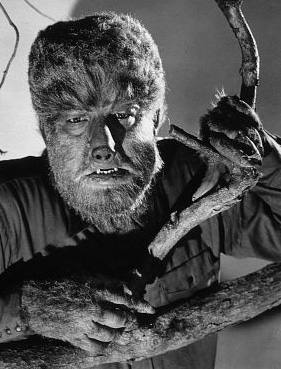
Armato: The Wolfman, Technique vs. Technology


Obviously, the 2010 version of The Wolfman has more advanced computer animation capabilities and is able to provide a more visually convincing transformation of the movie's main character into a wolf creature. While neither looks incredibly realistic (ignoring, of course, the nonexistence of werewolves), the 2010 version depicts a more believable process of transformation, rather than the 1941 method, which was simply a fade from human to creature.

If we look at these two transformation scenes in the context of available technology at the time of the films' releases, however, the 1941 version is far more impressive. The 2010 version's computer animation resembles a cartoon rather than a live-action sequence. Of course, the transformation sequence essentially is a cartoon, but other studios in these times produce far more convincing digitally animated sequences. Wolfman 2010 did not show any mastery of modern CGI technology, while Wolfman 1941 shows a mastery of the available special effects technology of its time.

Armato, Demo blog: Get Low

In this still from the recently released Get Low, Bill Murray's face is the dominant of the shot. Even in one frame, we can see that he is controlling the conversation at this moment. Even though Robert Duvall's face is prominentIt is closest to the camera—it is further to the left than Lucas Black's and Bill Murray's, and Black and Murray are both focused on Duvall—it's close proximity to the bottom of the screen allows room for Murray's face to be the the dominant.

The lighting key for this shot is high in the foreground. All the actors faces are brightly lit inside the barber shop. In the background, outside on the other side of the windows, the lighting is more natural.

The camera proxemics are certainly personal, but they come pretty close to being social. Only Duvall's torso is included in the shot while all but the very ends of Black's and Murray's legs are visible for them. As for the character proxemics, Duvall, Black, and Murray are in a social type of arrangement. Since none of them is in physical contact with another, the arrangement couldn't be called personal, and since no other characters are visible and these three are clearly interacting with each other, the arrangement couldn't be public.


On a side note, Get Low was a fantastic movie. A better story about guilt and forgiveness hasn't been told in years.