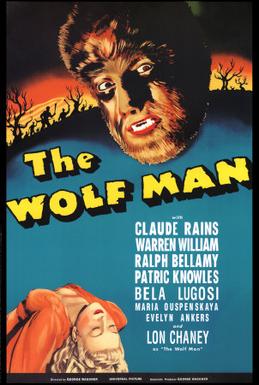
Sunday, September 19, 2010

Isaacson: Similarities and differences between The Wolfman(1941) and The Wolfman(2010)


One of the most striking things about The Wolfman(2010) is its visual style. The whole film appears to have been shot through a grey filter, which I believe was a way for the filmmakers to replicate some of the intense lighting effects seen in the original. The best time when this can be seen are the two films werewolf bite sequences. In both movies Lawrence and Larry chase the wolf attempting to protect an innocent victim. Both sequences have very low key lighting, attempting to replicate the lighting of the full moon alone, and both scenes are also heavily obscured by fog. However, there are also some notable differences between the original and the remake: length, technology, set design, and use of American and foreign actors. The original was a short film, 69 minutes, while the remake runs almost two hours at 119 minutes. Also, due to the vast difference in technology between 1941 and 2010 makes the direction of the film radically different, the original keeping much of the action hidden while the remake focuses on the gore of the werewolf's destruction. The set design is also radically different, with the village in the remake appearing far more rundown and foreign then the tidy, Americanized village of the original. Also, some of the remake occurs in different locations while all of the original is set in the village. Finally, we the exception of the gypsy women, nearly all of the characters from the original are very American. They speak with American accents and wear American style clothing. However, in the remake the filmmakers embrace the foreign setting. Even the origin of the protagonist is shifted, Larry coming from California and Lawrence coming from London. This is indicative of the shift in Hollywood that has occurred between the two films, with filmmaking now being more of a global enterprise and American filmmakers being less afraid that American audience won't be able to empathize with foreign characters.

Michael Arruebarrena: The Transformation of the Wolf man


The fact that Lon Chaney, Jr., the actor who plays the Wolf man in the 1941 version, puts on the wolf man makeup and outfit even 30 years after the movie was made brings light onto how revolutionary this movie was. The Wolf man (1941) was the second time a werewolf was put onto the big screen, and, though the effects seem cheap and unrealistic, they were spectacular for the time.

The transformation in the classic film was much more strategic. The frame focuses on Chaney’s feet as he grows hair then walks away. This method was a money and time saving technique. Yet, the transformation was affective and makes the viewer see the wolf man as more human. Also, the story line is held stronger. So the approach is to show the audience that he is changing, then show him completely changed, sort of a way to shock the audience. All of this transformation happening with a film orchestra playing a thrilling score.

When Benicio transforms, his bones realign. His feet bulge out, and he grows sharp fang teeth. Most importantly, the audience sees all of the changes. The effective result is the transformation feels realistic. What the film looses is the stylistic method in capturing a believable transformation without ever really showing any truly realistic effects.

Whether the older or the newer Wolf man is better becomes irrelevant. The times were completely different. The newest version lost its style in the transformation, while the older one was obviously not real. While the newer one gets multiple shots at different angles, the older one tries to keep one continuous show of his transformation illustrating the patience of the time. As the CGI improves, the more our spectators expect real looking, fast-paced special effects.

Armato, Demo blog: Get Low

In this still from the recently released Get Low, Bill Murray's face is the dominant of the shot. Even in one frame, we can see that he is controlling the conversation at this moment. Even though Robert Duvall's face is prominentIt is closest to the camera—it is further to the left than Lucas Black's and Bill Murray's, and Black and Murray are both focused on Duvall—it's close proximity to the bottom of the screen allows room for Murray's face to be the the dominant.

The lighting key for this shot is high in the foreground. All the actors faces are brightly lit inside the barber shop. In the background, outside on the other side of the windows, the lighting is more natural.

The camera proxemics are certainly personal, but they come pretty close to being social. Only Duvall's torso is included in the shot while all but the very ends of Black's and Murray's legs are visible for them. As for the character proxemics, Duvall, Black, and Murray are in a social type of arrangement. Since none of them is in physical contact with another, the arrangement couldn't be called personal, and since no other characters are visible and these three are clearly interacting with each other, the arrangement couldn't be public.


On a side note, Get Low was a fantastic movie. A better story about guilt and forgiveness hasn't been told in years.


Nolley, Wolfman Comparison

The Wolfman: 2010
The Wolfman: 1941

The 1941 Wolfman has some elements that the new 2010 version left behind. In the 1941 version the Lon Chaney is seen changing into the wolfman. This change is documented by his feet growing extremely hairy. It can definitely be said that the transformation into the wolfman is most definitely toned down in the 1941 version. This may take away from the overall scariness of the transformation, but it keeps the idea that there is still a man under that fur because his body has not been severely contorted. In the 2010 remake, Benicio Del Toro is extremely frightening when he transforms because of the dramatic changes his body goes through. It was almost too much, the way his fingers bent and how his jaw practically came off of his face. One thing that is worth admiring about the remake is that after he transforms and when the viewer finally sees him in all his glory he is not computer generated. This is reminiscent of classic horror movies where you can tell there’s a person in there. It also helps reinforce that Lawrence Talbot is a wolfman, not just a wolf creature with no obvious human characteristics. While the remake of The Wolfman is indeed more frightening than the original, that does not make it better. The computer generated effects of the remake take away from the genuineness of the film because the audience becomes distracted by what’s fake and what’s real and can lose track of the story itself. The 1941 Wolfman has an originality that the remake could never compare to.


Labbe's Werewolf Comparison


The werewolf film remake is more visually impacting due to the technological advances that have been made after 70 years.

In George Waggner’s 1941 The Wolf Man, viewers see Lon Chaney sit in a chair while his feet grow more hairy in evident multiple shots. Next, we see him as a full furry-faced werewolf with uneven teeth. Waggner spent more time on the transformation from werewolf to man at the end of the film. The shots are still clipped, but the camera angle doesn’t change while the hairy Wolf Man slowly changes back into human Larry.

Waggner might have imagined Joe Johnston’s 2010 The Wolfman, but didn’t have the means to create the nightmare. Past the invention of computers, photo manipulation can help current directors achieve almost any look they imagine.

Johnston imagined a grotesque monster, and the viewer saw it.

The main transformation scene took place in the asylum while he was tied down. The viewer saw Del Toro’s knuckles pop and eyes change shape from human to animal.

Film clarity and stunning effects aside, other elements made the newer version scarier.

In 1941, an average gentleman-looking Lon Chancery Jr. played Larry Talbot. Benicio Del Toro, a man with thick eyebrows and a strong jaw line, played Lawrence Talbot. The second werewolf was more menacing even before any special effects or acting.

In 1941, a fully clothed and clean werewolf ran on tiptoes after his victims. In 2010, the monster ran on all fours in ragged blood stained clothes. The original werewolf caught his victim and held her close as if in an embrace, any violence hidden behind a tree. In the remake, heads were ripped off bodies and red blood sprayed everywhere.

Rickert Wolfman Blog


The advancement of technology has played a prominent role in the 2010 Wolfman film. Advancement of technology is specifically understood within the scene of transformation from man to wolfman. In the 1945 version of Wolfman the transformation of Chaney’s full body is not shown in his transformation into Wolfman. Instead the audience is shown a succession of shots edited together of Chaney’s legs growing thick hair and turning into the feet of the wolfman. The audience then realizes that Chaney has turned into a wolfman without fully showing the full transformation. This transformation is a stark contrast to the latest 2010 version of the film Wolfman. In this newer version the audience has full view of Del Toro’s transformation this is possible because of the CGI. The audience views his hands forming into claws, human feet into larger animal like feet, and face becoming that of the wolfman. The audience can experience an almost life like transformation of Del Toro where in Chaney’s transformation the audience must implement more imagination. Chaney’s transformation can be understood as more intense build up of the horror of the wolfman for the audience. This is mainly because the audience does not see the wolfman till more than half way through the movie. Therefore there is an air of uncertainty of the appearance of the wolfman, allow the audience to formulate their own idea of the monster.
Both films incorporate the greatest forms of technology and cinematic effects to successfully communicate the transformation of the wolfman. There is no real answer to the more effective style of cinematic effects whether it be CGI or absence of main character to build suspense. Both films will live on to delight the imaginations and minds of the audience for years to come.

Villavicencio- Wolf Man vs. Wolfman


Written by Curt Siodmak and directed by George Waggner, the 1941 film “The Wolf Man” tells the story of a cursed man who regrettably transforms into a murderous werewolf at the arrival of a full moon.

Unlike many classic remakes, Director Joe Johnston’s 2010 version, “The Wolfman,” manages to preserve the original film’s plot rather accurately. Despite obvious differences such as character details and running time, “The Wolfman” remains relatively true to the initial story.

One of the most notable, and obvious differences, however, could be the transformation from human to monster. Although both films provide decent depictions (given the technology available at the time), I believe the original version to be more innovative as a whole.

To begin with, “The Wolf Man” stalls transformation until about 40 minutes into the film. This approach allows not only for a better understanding of character relationships, but also for the building of suspense. When Lon Chaney finally transforms into the wolf man, one can only see the changes in small portions, such as the shot featuring solely the man’s feet as they grow long, thick strands of hair. (Curious as to how this was accomplished, I found that a slow process of photograph overlapping featuring different stages of makeup was used to illustrate a smooth change.)

In the 2010 film, CGI effects allowed for an excessively gruesome transformation, as the characters fingers and toes vividly break and mutate into animal limbs, cheekbones protrude violently from each side of the face, and carnivorous pointy teeth grow into place. The changes of each body part are significantly more details compared to the older film; yet, I believe the technique falls comparatively short to other films of this time.

Overall, the way in which the 1940 film managed to create a slow, mysterious change from man to monster is more impressive given the great time, effort, and manual work required for its success.

Wolfman 2010 Trailer